
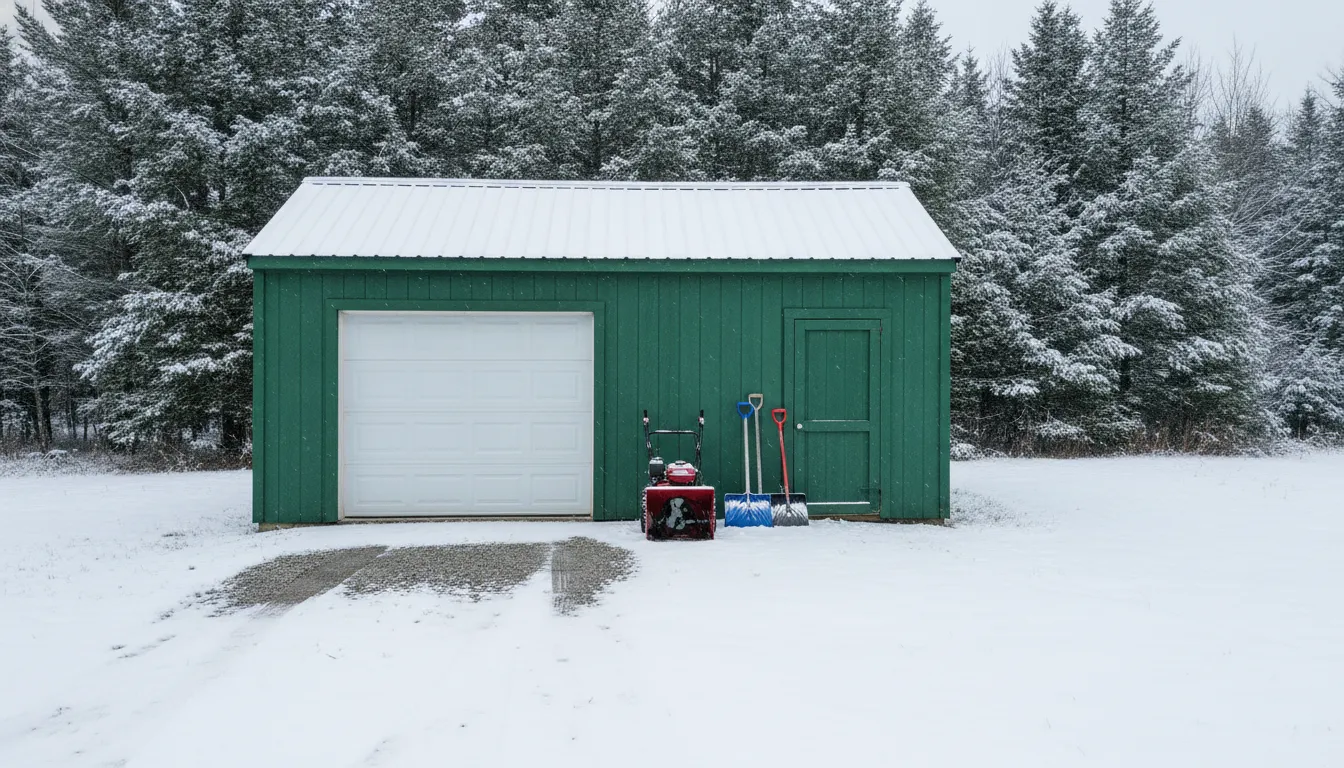
Portable garage snow storage works when the bay fits the vehicle and the snow gear, and when the site still lets you get in after a storm. A car that fits easily in July can lose that fit once a snowblower, shovels, and a salt bin move inside for the season. Plan the full winter mix before you order a building.
Call (518) 544-2889 to plan your winter storage building
To compare portable garage sizes and styles, visit the portable garages page.
This guide is for a delivered wood garage around Hudson Falls, New York, not a fabric canopy with a published snow rating. You will measure the vehicle, add floor space for winter tools, pick a garage style, choose a dry site, and plan a clear path from the drive. If you are still comparing models and materials, start with the portable garage buyer's guide, then come back here for the winter layout.
What should share the bay in winter?
Write down every item that must stay inside from the first plow through the spring thaw. Most Hudson Falls households need one daily vehicle plus the tools that clear the drive, and those tools take more floor than people expect. A two-stage snowblower needs a real walking lane, not a tight corner beside the tire.
List the vehicle first, including length, width with the mirrors out, and height with a rack or antenna still attached. Then list the snow kit that has to live beside it:
- Snowblower or small tractor with the chute folded.
- Shovels, a roof rake, and a push broom.
- Ice melt or sand in a closed bin.
- Fuel can stored only as the label allows.
- Spare wiper blades, a scraper, and a small mat for wet boots.
Keep summer mowers and holiday bins out of this plan when they can live in another building through the cold months. A loft can hold light seasonal bins, but it should not hold a snowblower you need before dawn. Heavy gear belongs on the floor, where you can roll it out without climbing a ladder in boots.
Also decide what must stay dry versus what can wait outside for a day or two after a storm. A daily car and a snowblower belong inside, while a spare set of tires can often wait in a shed. That split keeps the garage from turning into a packed closet by January.
How much floor does portable garage snow storage need?
Start with the parked vehicle, then add the working space you will actually use in a coat and boots. Leave about 3 feet on the driver side so a door can open. Leave at least 2 feet in front of the bumper so you can reach the house door without climbing over a plow blade.
Snow equipment needs its own zone, not the leftover strip beside a tire. A walk-behind snowblower often needs a pad about 3 feet wide and 5 to 6 feet deep, plus room to pivot the chute. A small tractor or ATV with a blade needs a full parking stall of its own. Measure your machine with the handles up. Do not trust the brochure width alone.
Add a wall zone about 2 feet deep for shovels, the roof rake, and the melt bin. If that zone sits behind the bumper, add its depth to the building length, and if it sits beside the car, add it to the width instead. One of those zones is enough for most homes, so do not add both unless you truly store gear in two places.
| Winter mix. | Floor to plan. | Style that usually fits. |
|---|---|---|
| Motorcycle or zero-turn plus a snowblower and shovels. | About 10 by 16 to 12 by 20 feet. | Utility garage with 8-foot sidewalls. |
| One car plus a snowblower, shovels, and a melt bin. | About 12 by 24 to 14 by 28 feet. | Utility garage, or a wider single bay. |
| One car, a tractor or second machine, and snow tools. | About 14 by 32 feet or a 24-foot-wide bay. | Long utility garage or double-wide garage. |
| One car plus light bins only, no floor machine. | Vehicle footprint plus a 2-foot wall zone. | Lofted garage if bins can go overhead. |
These ranges are planning starts, not a promise that a listed size is in stock. Legacy Structures utility garages run from 10 by 10 up to 16 by 40, depending on location. Lofted garages use the same footprints, with overhead storage in place of full 8-foot sidewalls. A double-wide garage is 24 feet wide and comes in lengths from 24 to 40 feet when you need two machines side by side.
If the only way the car fits is by parking tight against the wall, the bay is too small for a real winter. Door swing, a wet coat, and a snowblower will use that last foot on every storm night.
Which garage style fits a snow season?
Match the style to where the snow gear has to sit all season. A utility garage has 8-foot sidewalls, a 2-by-3 window, a solid house-style door, and a roll-up garage door. That taller wall helps a car with a rack, and the side door still opens when the big door is drifted shut. It is the usual pick when the snowblower lives on the floor beside the car.
A lofted garage trades those tall sidewalls for overhead loft space, so use it when winter storage is mostly bins, tires, and holiday gear and the vehicle is the only thing on the floor. Do not plan the loft as a home for fuel, salt, or anything you must reach during a storm, because climbing a loft ladder in boots is a bad January habit.
A double-wide garage is the clearer choice when two vehicles, or a car and a tractor, must come and go all winter. It is delivered as two built halves and joined on site, and it includes two roll-up doors, a 9-lite entry door, and four 2-by-3 windows. The extra door matters on the mornings when one bay is plowed in and the other is still clear.
Wood garages from Legacy Structures are built off site, delivered, and set on the spot you choose. They are not steel-tube fabric shelters, and the product page does not publish a canopy-style snow rating. Fabric-shelter ads often lead a search for this topic, but they answer a different product question. Ask Legacy Structures about the building, your town, and the site, and do not copy a canopy wind or snow number onto a wood garage.
How do you keep the site usable after snow?
A good winter site is level, firm, and well clear of the meltwater path. The building sits on the surface so it can be moved later. Low ground that ponds in March will pond under the floor after every thaw, so walk the spot in wet weather instead of judging it on a dry summer afternoon.
Leave a work apron in front of the roll-up door. A practical apron is at least as wide as the door and 8 to 10 feet deep, so you can stop, open the door, and turn a snowblower without backing into a bank. The apron should slope away from the door, not toward it. Roof melt that runs back under the threshold will freeze into a ridge.
Keep the approach clear of the things plows bury. That means no low posts, hose bibs, or edging inside the plow path. Overhead, look for limbs that drop ice onto the roof or the door track. Delivery also needs a straight, firm path. Placement rules can depend on access, building size, and local codes, so confirm the route before winter locks the yard.
New York snow is local. Ground snow load is set from the Building Code of New York State and the local table your town uses, and sites above 1,000 feet can need a higher value. Washington County yards are not all the same. A lot near the Hudson can differ from a hill lot. Ask the local building department what applies to your parcel before you treat any map as your design load. Legacy Structures can walk through delivery and placement. Your town confirms the rule.
How do you keep winter access clear?
Plan the path you will use at 6 a.m., not the path that looks open on a mild October afternoon. The roll-up door should face the drive you already plow, and a side house door should face the walk to the house, so you are not opening the big door just to grab a shovel.
Put the snowblower on the door side of the bay, nose out, with the chute folded, and hang the shovels and roof rake on that same wall between the machine and the door. Keep the melt bin off the walking line. If you have to move the car before you can reach the blower, the layout will fail on the first heavy night.
Leave a place to drop snow that is not the apron and not the neighbor's drive. A roof that sheds toward the only walk will rebuild that walk after every storm, so note which way the roof pitches before you decide which wall gets the door.
- Plow or blow a lane to the roll-up door before you open it.
- Clear the side door and the walking path to the house.
- Pull the snowblower straight out.
- Do not pivot it against the car.
- Push apron snow to the storage pile, away from the threshold.
- Check that meltwater still runs away from the door.
Salt and sand should stay in a closed bin, because loose pellets on a wood floor hold moisture against the boards. Fuel for the blower stays in an approved can, capped, and only in the spot the label allows. If that spot should not be inside a vehicle bay, keep the can in the shed you already use for mower fuel.
What should you ask before winter weather?
Bring the measurement sheet when you talk with Legacy Structures, and include photos of the vehicle, the snowblower, and the yard so the conversation starts from the real mix rather than a guess. Call or text 518-544-2889, or start from the portable garages page and ask which sizes match that mix.
Ask these questions before you order:
- Which in-stock or buildable size fits the vehicle plus the snow zone?
- Does this style have 8-foot sidewalls, or is the wall height given to a loft?
- Where can the roll-up door and the house door sit for your plow path?
- What site does delivery need?
- What placement rules apply at your address?
- Who do you call if you move later and the building has to be relocated?
Do not ask the dealer to invent a snow-load rating the product page does not publish, but do ask them to confirm delivery, setup, and the style details for your town. If you need two vehicles inside all winter, look at the double-wide sizes instead of squeezing a second car into a single bay.
Permits are separate from the purchase, and a portable building can still need a local permit, a setback check, or a zoning review. The buyer's guide covers that buying question in more depth. For this winter plan, call the building department with the footprint and the site sketch before snow season, not after the delivery truck is already booked.
Ready to match a bay to your vehicle and snow gear? Call Legacy Structures at 518-544-2889.
What roof and storm habits matter?
Snow on a roof is a safety question, not a weekend chore to improvise. Drifting snow, rain that soaks a snowpack, and a drain path blocked by ice can all pile more weight on one part of a roof. Warning signs include a sagging ceiling, doors that suddenly stick, new cracks, or a leak you did not have last week. If you see those, stay out and get a qualified person to look before anyone tries to clear the roof.
The Occupational Safety and Health Administration lists clearing snow from roofs and working at heights among winter hazards, along with slips on ice. That guidance is written for workers, and the same hazards apply at a home garage. Do not climb a snow-covered roof, and do not send someone up because the bay is full. Use a roof rake from the ground only if you can do it without standing under a sliding sheet of snow.
Day to day, keep the door track free of ice, and keep the apron from forming a frozen dam that pushes melt back toward the threshold. After a storm, look at the eaves, because a side packed much deeper by wind is drift, and drift weighs more than a smooth blanket of the same depth. Note that difference and ask for help if the building is not shedding snow on its own.
Vent the bay when a wet car comes in, using the 2-by-3 window on a utility or lofted garage for airflow rather than covering it with bins. Open it a crack on a mild day so melt from the undercarriage can dry. Trapped moisture is harder on stored tools than cold air is.
None of this replaces a local design check. For the load number your town uses, start with the New York State building standards and codes page, then confirm the figure with your building department. Before anyone clears a roof, read the OSHA winter weather hazards page and keep people on the ground.
A simple planning sheet
Copy this list onto one page and fill in every line before you compare buildings, so the winter question stays separate from catalog browsing.
- Vehicle length, width with mirrors, and height with the rack on.
- Snowblower or tractor length and width with the chute folded.
- Wall zone for shovels, roof rake, and the closed melt bin.
- Door you will use at 6 a.m., and which way the roof sheds.
- Apron depth in front of the roll-up door, sloped away from the building.
- Where plow snow will go so it does not bury the doors.
- Wet-season photo of the pad, plus any low spot that holds water.
- Town contact for snow load, permits, and setbacks.
When the sheet is full, compare it with real footprints on the portable garages page. If you also need a place for mowers and dry goods, a separate storage building can take that load so the garage stays a winter bay, and the storage buildings guide walks through that choice. Current models are listed on the building inventory page.
A bay that fits in October and still fits in February is the whole point of the plan. Measure the snow gear as if it already lives in the building. Then pick the style, the site, and the door that let you reach it when the drive is white.
Have your measurements ready? Call (518) 544-2889 to talk through your portable garage snow-storage plan.
Frequently asked questions
Can I store a car and a snowblower in one portable garage?
Yes, if you plan both footprints before you pick a size. A single car plus a walk-behind snowblower, shovels, and a melt bin usually needs more than a tight one-car pad, and many households land around 12 by 24 to 14 by 28 feet. Measure your car with the mirrors out and the blower with the handles up, then add a lane for the door to swing.
Does a portable garage need a permanent foundation for snow?
No. These buildings sit on the surface so they can be moved later. What they do need is a level, firm, well-drained pad and an apron that slopes away from the door. Ask Legacy Structures about delivery limits for your yard, and ask your town about permits and setbacks.
Is a loft a good place for winter snow equipment?
A loft is fine for light bins and seasonal goods, but it is a poor home for a snowblower, a fuel can, or salt you need during a storm. Those items belong on the floor, near the door you will actually use. If the loft is the only extra space you can find, choose a utility garage with 8-foot sidewalls instead.
How do I handle deep snow on the roof?
Watch for sagging, stuck doors, new cracks, or leaks, and keep people off a snow-covered roof. OSHA warns that falls and collapse are the main hazards when snow is removed from roofs and other high surfaces. Use a roof rake from the ground only when you can stay clear of sliding snow. If the roof looks stressed, call a qualified person instead of climbing a ladder.
What should I confirm with my town before I order?
Confirm ground snow guidance, permit rules, and setbacks for your parcel. New York uses the state building code, and the local table can change with elevation, so a published fabric-shelter snow rating does not transfer to a wood portable garage. Your building department is the right source for the number that applies to your site.