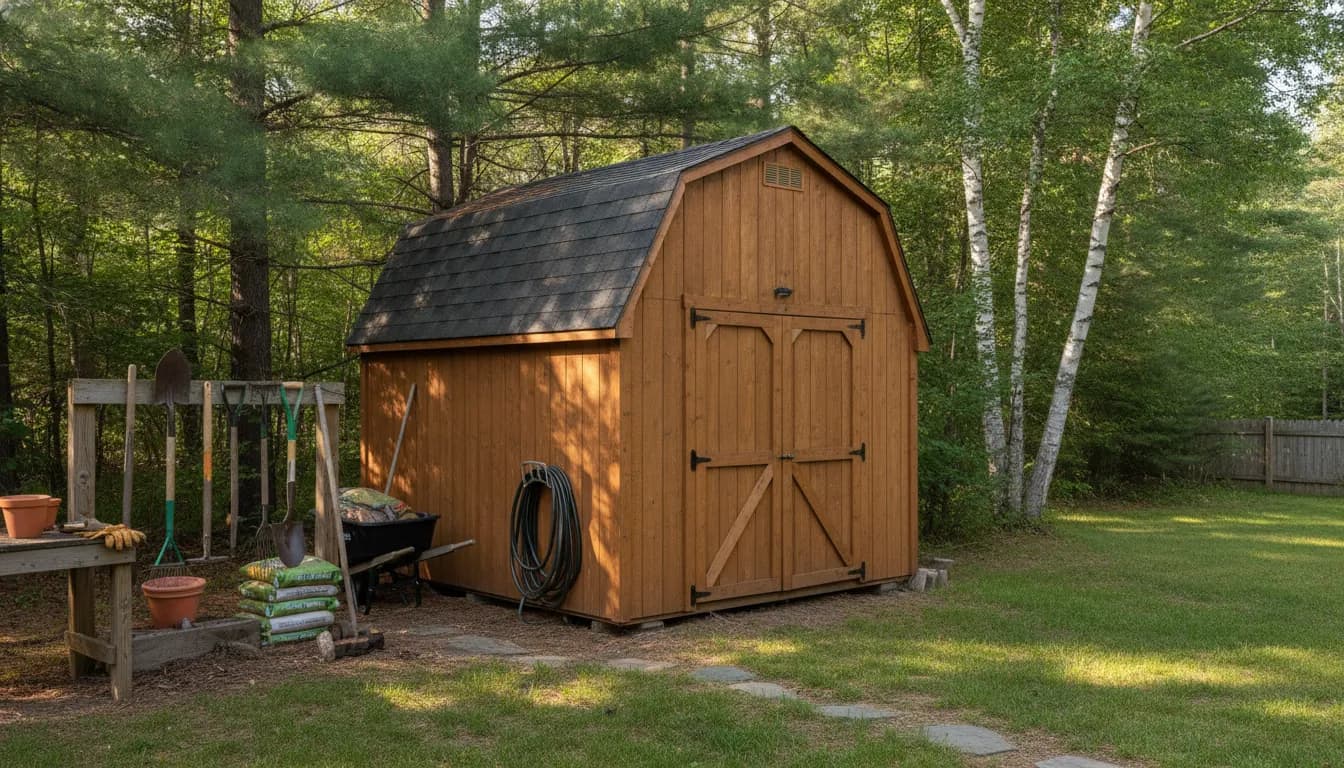
If you are asking what is a mini barn shed, you are probably comparing a compact barn-style building with a standard storage shed. A mini barn is an entry-level backyard barn with a barn-style roof and 4-foot sidewalls. It is designed primarily for tools, lawn equipment, seasonal items, and other belongings that need a protected place outside the home.
In short: a mini barn gives you the look of a small barn in a compact, portable format. Its modest wall height makes it useful for organized ground-level storage, but you should not assume that every model provides standing room, a loft, or clearance for tall equipment. The best choice depends on your storage list, door opening, available footprint, site access, and local requirements.
Call 518-544-2889 to discuss your storage needs and request the FREE Pricing Guide.
This guide explains the differences between a mini barn and other shed styles, how to choose a size, what fits inside, and how to compare the cost with a larger shed. For the broader decision process, start with Legacy Structures' complete storage shed buying guide. Then use the mini barn details below to decide whether this compact format suits your Hudson Falls or Adirondack property.
What Is a Mini Barn Shed? A Clear Definition
A mini barn shed is a compact storage building with a recognizable barn-style roof and 4-foot sidewalls. The roof creates the classic barn appearance, while the smaller footprint and lower walls keep the building focused on practical backyard storage. It can hold garden tools, outdoor equipment, bins, toys, and seasonal household items without requiring a full garage or a larger barn.
The roof shape should not be confused with full interior height. The sidewalls are lower than those on many utility sheds, and headroom changes as you move beneath the sloped roof. A mini barn may be a poor fit for a standing-room workshop, office, or tall shelving plan unless the exact model and configuration provide the needed clearance. Measure your largest items before choosing.
Mini barns are portable buildings. They sit on or above the ground on a suitable prepared surface, such as a gravel pad, blocks, pressure-treated skids, or sleepers. They are not intended to be frozen or embedded below the ground. A prepared, reasonably level site still matters for delivery, drainage, access, and long-term use.
Mini Barn vs. Standard Storage Shed: What Is the Difference?
The main difference is the combination of roof profile and wall height. A mini barn has a barn-style roof with 4-foot sidewalls. A standard or utility shed generally uses a more conventional shed layout, with sidewalls that can reach up to 8 feet. A lofted barn offers a barn appearance with taller 6-foot-3-inch sidewalls and up to 8 feet of overhead loft storage, depending on the selected configuration.
| Building type | Profile | Best fit |
|---|---|---|
| Mini barn | Barn-style roof with 4-foot sidewalls | Compact, ground-level storage for tools, equipment, and seasonal items |
| Standard or utility shed | Conventional shed layout with sidewalls up to 8 feet | More vertical clearance for tall storage, a work area, or office-style use |
| Lofted barn | Barn-style profile with taller walls and overhead loft space | More capacity when you want floor storage plus a loft |
Choose a mini barn when its compact footprint, barn character, and modest wall height match the way you store things. Choose a utility shed when standing room or tall wall storage matters more. Consider a lofted barn when overhead capacity is a priority. The names alone do not determine usable space, so confirm the dimensions, doors, and features for the exact building.
When comparing options, keep the larger plan in view. The storage shed buying guide covers footprint, access, capacity, site fit, and budget across the full selection. Those same questions make a mini barn comparison more useful than choosing by roof shape alone.
Typical Sizes and Configurations of a Mini Barn
Legacy Structures mini barns are available in 8-, 10-, and 12-foot widths, with lengths ranging from 8 to 24 feet depending on the selected width. That range can accommodate a compact tool shed, a longer equipment building, or a storage plan that needs room for seasonal items. The right size is the one that leaves enough space to use the building, not simply the largest footprint that fits the yard.
Measure the site before selecting a footprint
Mark the proposed length and width, then account for door swing, drainage, maintenance, snow clearing, and a comfortable approach. Check fences, trees, gates, property lines, utility equipment, driveway turns, overhead branches, and the route needed for delivery. A building can fit on a sketch and still be frustrating if the door faces a fence or equipment cannot reach the entrance.
Match the doors to your largest items
Mini barn configurations include a single 8-foot barn door option. Double doors are available in 10-foot and 12-foot configurations. Measure the width and height of mowers, snow equipment, bins, and other bulky items, including handles and attachments. Leave room to turn equipment toward the door. A wider opening can be valuable even when the building itself is compact.
Review siding and finish choices
Available mini barn siding options include pressure-treated T1-11 and LP SmartPanel. Finish choices include pressure-treated, painted, or polyurethane options. Consider the appearance of nearby buildings, how much maintenance you want, and how the structure will fit your home, garage, fence, or landscape. Confirm current options for the specific model before ordering.
What Can You Store in a Mini Barn?
A mini barn works best as organized outdoor storage rather than as a small garage. Common uses include hand tools, garden tools, hoses, watering equipment, folding tables, outdoor games, planters, and smaller lawn-care equipment. It can also keep sleds, coolers, patio accessories, holiday decorations, and other seasonal items out of the garage or basement.
Plan the interior around access. Keep frequently used tools near the entrance, group long-handled tools along one wall, and use labeled bins or shelving for smaller items. A mower, trimmer, snowblower, or other bulky item needs room to turn and exit. Measure the equipment and add clearance instead of packing the floor to its exact dimensions.
The 4-foot sidewalls are the key limitation to remember. Do not assume that a mini barn has comfortable standing room, a usable loft, or enough height for tall shelving. If you need a workbench, an office-style interior, frequent indoor work, or generous vertical storage, compare a utility shed or lofted barn. If the goal is compact, accessible storage with a classic roofline, a mini barn may be a strong fit.
Is a Mini Barn a Good Fit for a Small Backyard?
Often, yes, when the building solves a defined storage problem and the site is planned carefully. A compact building can preserve more yard space than a full-size shed, but the footprint is only part of the decision. You also need room to open the doors, move stored items, manage water and snow, and reach the building for delivery and maintenance.
- List what will go inside. Measure the largest items and note which ones you use every week versus only seasonally.
- Mark the footprint and clearances. Include door swing, walking space, drainage, snow management, and access around the building.
- Confirm wall-height needs. A mini barn's 4-foot sidewalls may not suit standing work, tall shelving, or bulky vertical storage.
- Prepare an above-ground site. Use a suitable, reasonably level surface such as gravel, blocks, or pressure-treated skids, and plan for drainage.
- Check local requirements. Ask your municipality about setbacks, accessory-building rules, permits, and site restrictions at your address.
- Verify delivery access. Measure gates, driveway width, turns, slopes, branches, and obstacles between the road and the proposed site.
Upstate New York buyers should also consider winter access. Direct runoff and snowmelt away from the building, walkways, doors, and neighboring property. Leave a practical route for clearing snow, and discuss the proposed placement and building specifications before ordering.
How Much Does a Mini Barn Cost Compared to a Full-Size Shed?
There is no single price for every mini barn or full-size shed. The final amount depends on the footprint, doors, siding, finish, windows, and other options, along with delivery and site conditions. A compact building may use fewer materials than a larger structure, but a smaller footprint is not the only factor in value. The building still needs to hold your equipment, provide workable access, and suit the property.
The most reliable comparison is between two specific configurations. Legacy Structures' 3D shed builder lets shoppers compare size, style, roof, siding, doors, windows, and colors, then submit a configuration for pricing. Review the same storage list against a mini barn, utility shed, or lofted barn instead of relying on an old example or an unsourced dollar estimate.
Delivery and site work belong in the budget as well. Legacy Structures offers free delivery within 30 miles of Hudson Falls, with delivery beyond that area potentially available for a fee. Confirm the route, placement, local requirements, and any preparation needed before comparing quotes. A mini barn offers good value when its compact design meets your storage needs without requiring features or capacity you will not use.
Get the FREE Pricing Guide and compare mini barn configurations.
Frequently Asked Questions About Mini Barn Sheds
Does a mini barn shed have a loft?
Do not assume that it does. A mini barn's barn-style roof does not automatically provide a usable loft or standing room. Confirm the exact model, interior dimensions, and available features. A lofted barn is a separate option when overhead storage is important.
What size mini barn should I get?
Start with your largest items, the clearance needed to move them, and the space available on your property. Legacy Structures mini barns are available in 8-, 10-, and 12-foot widths, with lengths from 8 to 24 feet depending on the configuration. Verify the selected footprint and delivery route before ordering.
Can a mini barn fit in a small backyard?
It can, provided the footprint, door approach, drainage, delivery route, setbacks, and local requirements all work. Measure more than the building outline. You need practical clearance around the structure for access, maintenance, snow, and water management.
Is a mini barn better than a standard shed?
Neither is automatically better. A mini barn suits compact ground-level storage and a classic barn appearance. A standard or utility shed may be better for taller walls, standing room, a work area, or vertical storage. Compare the building profile with the way you will use it.
Call 518-544-2889 to compare a mini barn with the right shed configuration for your property.