
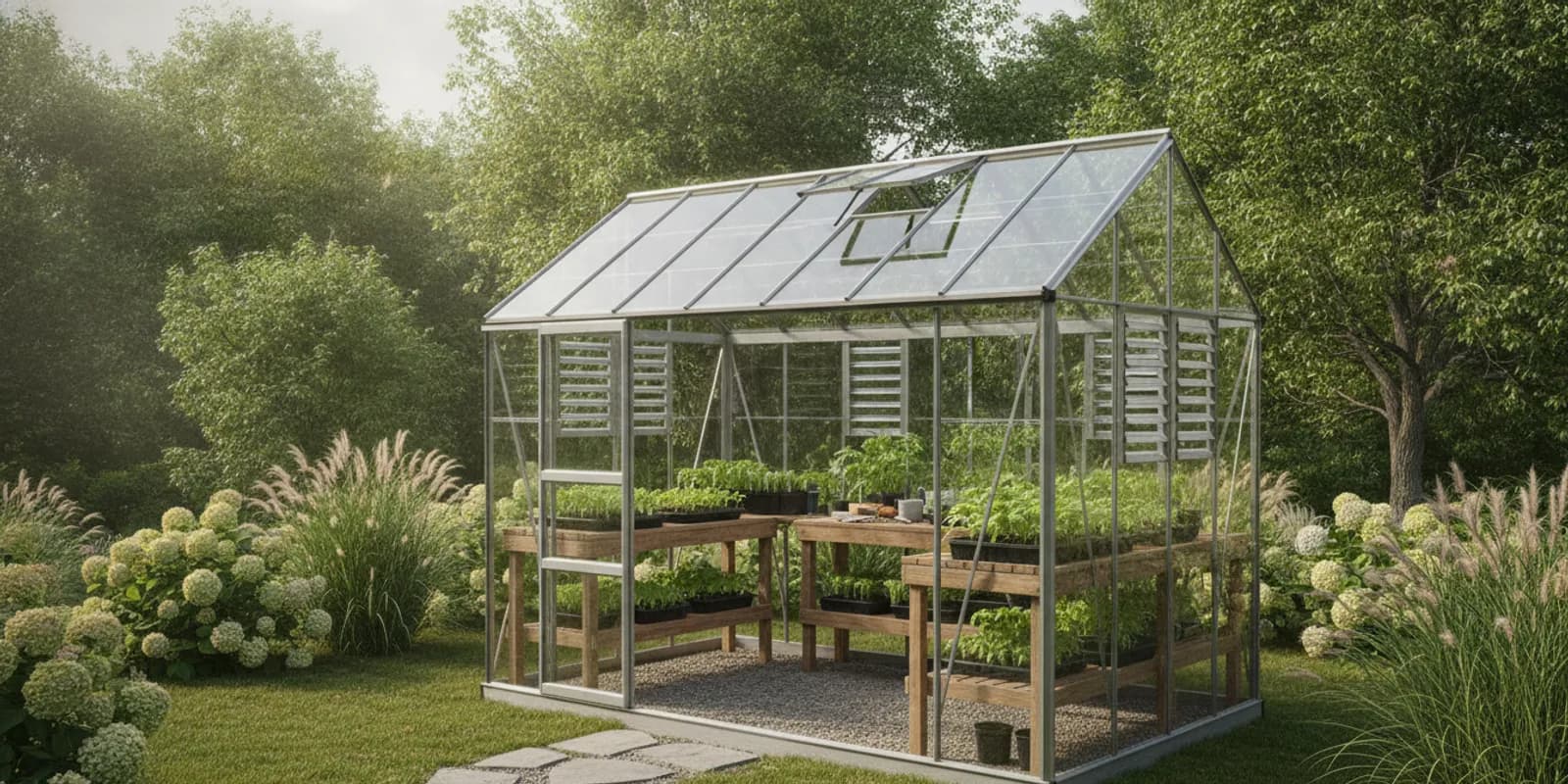
A small greenhouse can heat up quickly when sunlight enters and warm air has nowhere to go. A thoughtful small greenhouse ventilation setup gives excess heat and moisture a way out while helping fresh air move through the growing space. Before comparing structures, decide how you will open vents, whether circulation fans make sense, and how you will check conditions during the day. This practical plan complements a small greenhouse kit checklist by focusing on the separate question of airflow.
Talk with Legacy Structures about greenhouse options
What does ventilation do in a small greenhouse?
Ventilation exchanges warmer, humid indoor air with cooler outside air. In a sunlit enclosure, air temperature can rise even when the outdoor day feels comfortable. Opening vents provides a path for that heat to leave. Air movement also helps reduce stagnant pockets around plants, benches, and corners. The goal is not to make every part of the greenhouse match outdoor conditions. It is to manage heat and moisture in a way that suits the plants and the season.
Ventilation and circulation are related, but they are not the same task. Vents exchange indoor air with outside air. Circulation fans move air within the greenhouse. A fan aimed across the room may reduce still zones, but it does not replace an opening that allows hot air to escape. Likewise, an open vent does not guarantee that air reaches every crowded shelf or corner. Plan for both functions, then decide how much equipment the space actually needs.
There is no single setting that works for every greenhouse. Conditions depend on the enclosure, sun exposure, outdoor temperature, plant density, watering, and whether someone is present to adjust openings. Treat the setup as a system you observe and fine-tune rather than a one-time choice. The U.S. Botanic Garden's Greenhouse Manual describes electric fans as useful for increasing airflow and cooling a greenhouse, including horizontal airflow fans used to circulate interior air.
Where should you plan the air openings?
Think about the route air will take, not just the number of vents. Warm air tends to collect higher in the enclosure, so a high opening can help release it. Lower openings can provide a route for replacement air. When openings are positioned to support a path across the growing area, outside air can enter, travel through the space, and leave with accumulated heat. A vent that opens into an obstructed corner may not serve the same purpose as an opening with a clear route.
Sketch the greenhouse from above and from the side. Mark doors, windows, roof openings, benches, tall plants, shelving, and any fixed equipment. Then draw arrows showing where air could enter and leave. Look for dead ends: a dense plant row pressed against a wall, a tall shelf blocking a side opening, or a door that is the only opening on one end. Rearranging benches or leaving a gap beside an opening can sometimes improve the route without adding equipment.
Do not assume a door alone provides dependable ventilation. It can be useful when someone is present, but its opening may be inconvenient, exposed to gusts, or insufficient to exchange air across the full enclosure. Consider how vents can be reached safely and whether their operation fits your routine. Roof and side openings may offer different paths, and the best combination depends on the greenhouse design and site.
How should you match vent placement to the site?
Observe the site at different times of day. Note which side receives direct sun, where prevailing breezes seem to come from, and whether fences, buildings, or evergreen shrubs block airflow. A greenhouse tucked into a sheltered corner may need a different approach from one in an exposed garden. Nearby trees can provide shade, but they can also obstruct air or drop debris. Leave practical access around the structure so you can inspect, clean, and operate openings.
Sun exposure matters because it affects how much heat enters. If one side receives strong afternoon sun, monitor that side rather than relying on a reading near the doorway. Ventilation can release heat, but it does not erase the effect of intense sunlight. Shade management, plant placement, and the timing of vent adjustments all contribute to the environment. Plan the openings alongside the greenhouse location, not after the structure is already in place.
Wind can assist natural air exchange, but it is variable. A calm day may provide little help, while a gusty day can make an opening awkward to manage. Think about whether an opening can be secured or adjusted when wind shifts. Do not leave a door or vent in a position that could swing or strain simply because it seemed useful in one weather condition. Follow the greenhouse maker's instructions for operating and securing its components.
Which ventilation approach fits a small greenhouse?
There are three broad approaches: manual openings, assisted openings, and a combination of openings with fans. Manual operation may be enough when the greenhouse is close to the house, someone can check it regularly, and the plants tolerate modest variations. Assisted or automatic operation can be useful when a grower cannot be present at every temperature change. Fans can support air exchange or circulation, depending on their placement and purpose.
| Approach | What it does | Good fit when | What to plan for |
|---|---|---|---|
| Manual vents or door | Lets a person open and close openings as conditions change | The greenhouse is easy to reach and checks are part of the daily routine | Someone must monitor weather and respond; access and safe operation matter |
| Automatic vent opener | Opens a compatible vent as its operating mechanism responds to heat | You want a hands-off response at the vent while away briefly | Confirm compatibility, operating range, maintenance, and what happens in a power-free mechanism or changing weather |
| Exhaust fan with an air inlet | Moves air out and draws replacement air through a planned opening | Natural airflow does not provide the exchange you need, or conditions call for mechanical assistance | Size and placement depend on the enclosure; follow equipment instructions and provide an inlet path |
| Horizontal circulation fan | Moves air around within the greenhouse | Some areas remain still despite workable venting | It circulates air but does not by itself replace indoor air with outside air |
| Mixed approach | Combines openings and one or more fan functions | The layout, plants, or schedule calls for more than one airflow method | Coordinate controls, avoid obstructed paths, and test the complete arrangement |
The table is a planning comparison, not a specification. Fan capacity and vent sizing should not be guessed from a generic rule when the enclosure dimensions and equipment details are unknown. Check the greenhouse and equipment documentation, and ask a qualified supplier or installer when you need help determining compatibility. A smaller space still needs a deliberate air path; choosing a fan without planning an inlet can leave its performance disappointing.
When should you use a fan?
Start by observing what happens with openings alone. If the interior remains uncomfortably hot despite a clear, usable vent route, mechanical exhaust may be worth considering. If the main issue is still air in a particular area, circulation may be a better starting point. Identify the problem before buying equipment. More than one fan is not automatically better, and a fan pointed directly at delicate plants can create an undesirable localized draft.
For an exhaust fan, plan where outside replacement air will enter. The intake should not be blocked by plants, supplies, or a wall too close to the opening. Consider the route from intake to exhaust and whether it crosses the occupied growing area. For circulation, aim to move air around the enclosure rather than merely blowing into a nearby surface. Follow the fan maker's guidance for mounting, electrical safety, clearances, and wet environments.
Electrical equipment around water and humid conditions requires care. Use products intended for the setting, keep cords and connections arranged as instructed, and consult a qualified electrician if you are unsure about installation. Do not improvise wiring or place equipment where water can reach it. A practical ventilation plan includes safe power access, a way to inspect the equipment, and a backup plan for periods when electricity is unavailable.
How can you manage heat and humidity together?
Ventilation can help remove humid air, but it is only one part of moisture management. Watering practices, drainage, plant spacing, and the amount of foliage all affect moisture inside. Watering early enough for surfaces to dry before cooler evening conditions may help avoid an unnecessarily damp overnight environment. Avoid crowding plants so tightly that air cannot move between leaves. Remove spent plant material and keep walkways clear.
Do not treat a fan as a dehumidifier. A fan can circulate air, while ventilation exchanges air; neither guarantees a particular humidity level in every weather condition. When outside air is humid, opening the greenhouse may not lower indoor humidity as much as expected. When outside air is cool and dry, the exchange may change conditions quickly. Watch the plants and readings together, then adjust in small steps rather than making a large change based on one moment.
Temperature and humidity readings are most useful when their location is representative. A thermometer on a sunlit wall or directly above a heater can mislead. Place a monitor where it is shaded from direct sunlight and near the growing area, while avoiding direct contact with wet surfaces. If the greenhouse has distinct zones, compare more than one location during initial testing. Record the time, weather, vent position, and readings so patterns become easier to recognize.
How should you test the setup?
Test the greenhouse before relying on it for sensitive plants. On a mild day, open the vents as planned and check whether air can move through the main growing area. Then observe during a sunny period and again when the outdoor temperature changes. Note how quickly the greenhouse warms, whether the far end feels stagnant, and whether opening a vent creates a direct draft on a plant bench. Make one adjustment at a time so you can tell what changed the result.
- Map the layout. Mark openings, shelves, benches, plants, and likely intake and exhaust paths.
- Check access. Confirm that you can reach and operate vents without moving heavy items or stepping over plants.
- Observe conditions. Track temperature and, if useful for your crops, humidity at representative points.
- Adjust gradually. Change opening size or fan direction in small increments and observe the response.
- Repeat in different weather. A calm sunny day and a breezy or cloudy day may produce different results.
- Review after growth changes. Taller plants and fuller shelves can block a route that worked when the greenhouse was empty.
Keep a simple log rather than relying on memory. A few notes can show whether the greenhouse repeatedly warms at a particular hour or whether a specific shelf stays still. Include what you did, not just the reading: “roof vent half open, side opening clear” is more useful than a number without context. When plants show stress, check several possible causes, including watering, light, and temperature, instead of assuming ventilation is the only factor.
What changes during Upstate New York weather?
In a region with changing seasons, a ventilation plan should be adjustable. Warm sunny days can occur when nights remain cool. That makes it important to consider both daytime heat release and nighttime protection. A vent setting suitable for a bright afternoon may not be suitable after sunset. Decide who will close or adjust openings when conditions change, and make the controls straightforward to reach.
Wind, rain, and snow also affect how you use openings. Check that vents can be operated as intended and that water does not create an avoidable problem around plants or electrical equipment. Clear debris from moving parts and inspect them periodically. In cold weather, ventilation may still be needed for moisture or air quality, but prolonged opening can chill plants. Use plant-specific guidance and observe conditions rather than following a fixed calendar rule.
Seasonal planning starts with the crops you intend to grow. Some plants are more sensitive to heat or rapid temperature shifts than others. Make a list of the crops, their expected growing periods, and any temperature limits provided by reliable growing references or seed suppliers. That information will help you decide whether manual monitoring is realistic or whether an automatic response is worth exploring. It also makes conversations about greenhouse features more concrete.
What mistakes commonly undermine ventilation?
- Counting openings instead of planning a route. Several openings do little if air cannot travel across the space.
- Expecting a circulation fan to exhaust heat. Internal movement and air exchange are different functions.
- Blocking an inlet. Plants, containers, or stored supplies can obstruct replacement air.
- Ignoring future growth. A layout that is open in spring can become crowded later.
- Relying on a single reading. A monitor in direct sun or near an opening may not reflect conditions around the plants.
- Leaving adjustment until a heat event. Test vents and controls before a high-stress day.
- Overlooking safe operation. Fans and electrical components need appropriate installation and maintenance.
Avoid solving every problem by widening every opening. A sudden change can expose plants to strong drafts or a sharp temperature shift. Instead, make a measured adjustment and check the response across the growing area. If you are uncertain whether a problem is caused by airflow, shade, watering, or another factor, gather observations and seek crop-specific advice before making a major change.
How should you compare greenhouse options?
When evaluating a greenhouse, look beyond the footprint. Ask what openings are included, where they are positioned, how they operate, and whether the layout allows you to add or use suitable ventilation equipment. Consider the height and shape of the space, the placement of benches, and how easily you can reach controls. A design that looks spacious on a product listing may feel less convenient once shelves and mature plants occupy it.
Bring a simple sketch of the proposed site and intended interior layout to a conversation with a supplier. Note where the sun falls, whether the site is sheltered, and which sides need to remain accessible. Ask which openings are part of the structure and what additional equipment, if any, is compatible. Do not assume that a feature is included unless it is confirmed for the specific model. Legacy Structures offers greenhouses for sale; review the available options and confirm design details directly before deciding.
Use the greenhouse 8 x 12 listing as a starting point for questions about a particular structure, rather than assuming every listed configuration has identical openings or equipment. You can also view the broader building inventory while comparing options. Availability and product details can change, so confirm the current specifications before making plans around a specific feature.
What should you ask before ordering?
- Which vents or openings are included with this particular greenhouse?
- Where are the openings positioned, and how are they opened and secured?
- Can the proposed bench and shelving layout leave a clear route for airflow?
- What fan types or automatic openers are compatible, if I want to add them?
- What electrical requirements and installation precautions apply to any fan?
- How should the structure and openings be maintained through the seasons?
- What site preparation and access will be needed for delivery and installation?
- What details should I verify for my intended crops and growing schedule?
These questions keep the decision focused on actual use. If ventilation is a priority, explain whether you expect to check the greenhouse several times a day, whether it will be near your home, and what you plan to grow. Those details help you compare manual operation with equipment needs. They also prevent confusion between a building feature and an accessory that may need to be selected separately.
How do you choose a workable ventilation plan?
Begin with a clear objective: release excess heat, improve air movement around plants, or address both. Map openings and obstructions, consider the site and sun, then choose a monitoring routine you can maintain. Start with the ventilation features of the greenhouse itself. Add fans only when your observations point to a specific need, and follow product instructions for sizing, installation, and safe operation.
Keep the plan flexible. Plants grow, seasons change, and a greenhouse can behave differently as the interior fills. Check the airflow after rearranging benches, adding tall crops, or changing the location of equipment. If a setup repeatedly leaves a hot or stagnant area, adjust the route or seek practical advice rather than assuming that a larger fan alone will fix it. A simple, observable system is easier to manage than one with equipment you cannot safely access or maintain.
For a related decision about choosing a compact structure, revisit the small greenhouse kit planning checklist. Ventilation is one piece of choosing a greenhouse; footprint, access, intended crops, and site conditions matter too.
Call Legacy Structures at 518-544-2889 to discuss greenhouse options and the details you should confirm.
Frequently asked questions
Does a small greenhouse need a fan?
Not always. First assess whether the available openings provide a useful air path and whether you can monitor and adjust them. A fan may help when observations show that natural exchange or internal circulation is not meeting your needs. Choose equipment for a specific purpose and follow the manufacturer's guidance.
Is opening the door enough?
A door can contribute to air exchange, but it may not create a dependable route through the full greenhouse. Its usefulness depends on placement, weather, and whether it can safely remain open. Consider dedicated vents and the location of plants and shelves as well.
Where should I place a thermometer?
Place it near the growing area, out of direct sunlight and away from wet surfaces or concentrated heat sources. If the greenhouse has distinct zones, compare readings in more than one location during testing. A representative reading is more useful than one taken beside a door or against a sunlit wall.
Can ventilation control humidity on its own?
Ventilation can remove some humid indoor air, but results depend on outdoor conditions and the amount of moisture being added. Watering, plant spacing, and air circulation also affect the environment. Monitor conditions and adjust the whole growing routine rather than expecting a vent or fan to control humidity by itself.
How often should I adjust the vents?
There is no universal schedule. Check conditions as sunlight, outdoor temperature, wind, and plant growth change. Establish a routine that fits your crops and site, and test the openings before relying on them during a hot spell. Close or adjust openings when changing weather makes the current setting unsuitable.
A good ventilation plan is one you can understand, operate safely, and revise as the greenhouse fills with plants. Map the air path, watch conditions in the growing area, and confirm the available features before choosing a structure.