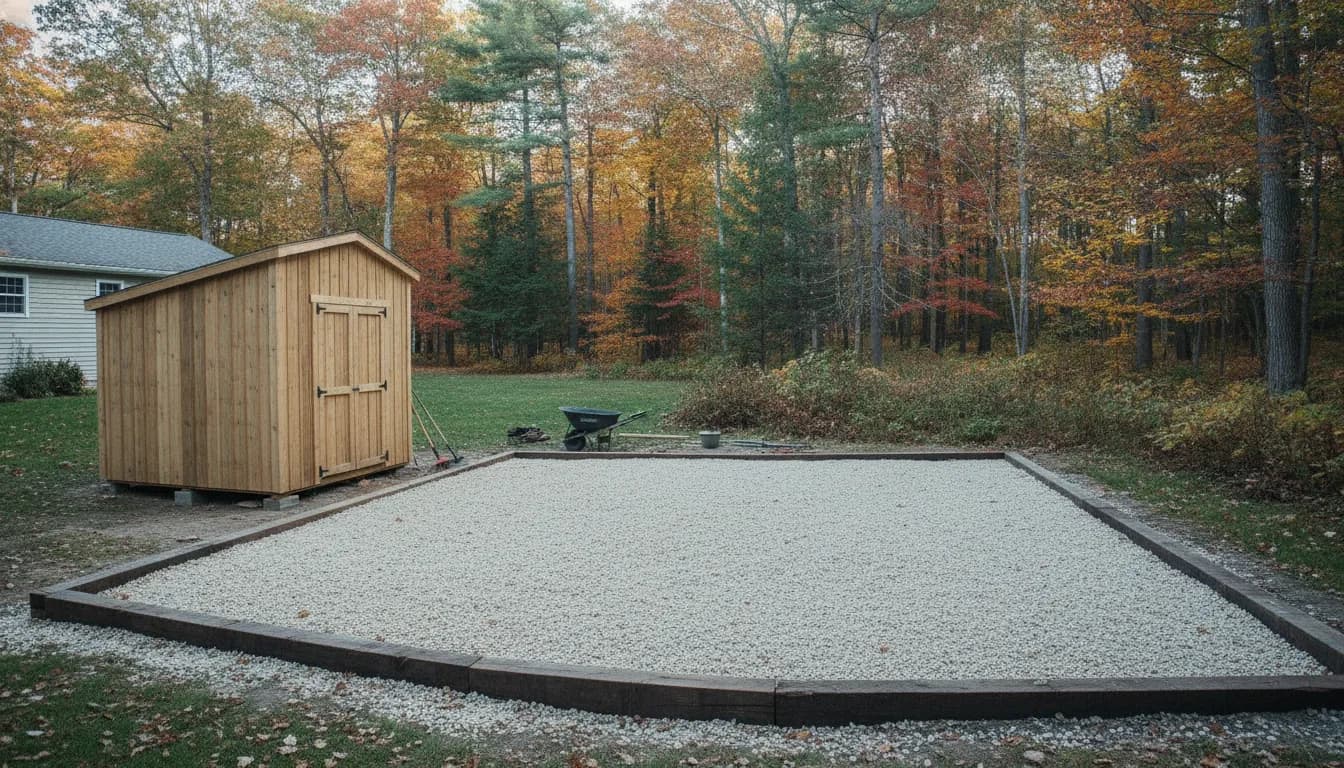
In Upstate New York, a shed site can look level in summer and still hold too much moisture after a hard rain or spring thaw. The best preparation starts before delivery. Choose a practical location and clear vegetation and obstacles. Confirm the shed footprint, then create a firm surface that will stay level and drain well.
Knowing how to prepare ground for a shed on skids means building a level, stable, well-drained area on or above the ground. Suitable supports may include gravel, skids, sleepers, blocks, or pavers. The right approach depends on your soil, slope, drainage, access, shed size, and local requirements.
Site preparation is the homeowner's responsibility, but Legacy Structures can provide preparation guidance before delivering and installing a building on a prepared site. Before choosing materials, it helps to understand why small problems with water, slope, or support can affect the entire installation.
How to Prepare Ground for a Shed on Skids and Protect Your Installation
A shed needs more than an open spot in the yard. The ground should be level, stable, and well drained before delivery. In Upstate New York, seasonal moisture, freeze-thaw conditions, and spring runoff can expose weak preparation quickly. A site that looks firm in late summer may soften after rain or winter weather, so plan for the conditions your property experiences throughout the year.
Begin by choosing a location that matches the building footprint and leaves practical room around it. Clear grass, brush, roots, branches, and loose organic material from the support area. Then evaluate the soil. Soft ground, standing water, or a naturally wet drainage path may need grading or a defined gravel-supported area before the shed arrives. Water should move away from the structure rather than collect beneath it, where ongoing moisture can contribute to settling and deterioration. A level surface also helps the building sit properly on above-ground supports such as skids, sleepers, gravel, blocks, or pavers.
Do not overlook access. Measure the route from the road or driveway to the final location, and check for low branches, hanging wires, narrow turns, gates, holes, and other obstructions. Legacy Structures uses specialized equipment for precise placement, but the delivery path still needs to be safe and workable. Confirm the intended footprint and site conditions with the supplier before installation, especially if your property has a slope or limited access.
Site preparation remains the homeowner's responsibility, while Legacy Structures provides preparation guidance and installs buildings on prepared sites. The company's treated decking and water-sealed siding are not substitutes for a sound base. If you are comparing storage sheds in Washington County, ask about the support approach for your property and confirm local setback, permit, drainage, and anchoring requirements with the relevant authority.
Do Portable Sheds Need a Foundation?
Usually, a portable shed does not need a permanent buried foundation. It does need a prepared base that is level, stable, and well drained. The right setup may include a gravel pad, pressure-treated skids or sleepers, blocks, pavers, or another suitable above-ground support system. These options support the building while allowing it to be moved or re-sited when necessary.
Think of the base as site preparation, not a conventional house foundation. Clear vegetation and organic debris, remove obvious soft spots, and create a support area that matches the shed footprint. The surface should not leave water standing beneath the structure. A well-prepared base helps limit settling and keeps moisture from affecting the building over time. Legacy Structures delivers and installs buildings on prepared sites, so site preparation remains the customer's responsibility, with guidance available before delivery.
What matters more than a permanent foundation?
The support method should match the ground conditions, shed design, access plan, and local requirements. A gravel pad may be practical on one property, while skids or carefully placed blocks may work better on another. Before choosing an approach, confirm the shed dimensions, inspect drainage patterns, and consider whether delivery equipment can reach the site safely. You can also compare storage shed options before finalizing the footprint and support plan.
Rules are not identical everywhere. Setbacks, permits, drainage provisions, and anchoring requirements can vary by municipality and property. Ask the relevant local authority what applies to your site, then coordinate the support and anchoring details with your shed provider. The goal is a properly supported building sitting on or above the ground, not a structure frozen, buried, or embedded below the frost line.
A Gravel Pad Is Often the Most Practical Base
For many movable sheds, a properly prepared gravel pad offers a practical balance of drainage, stability, and access. It keeps the building supported on or above the ground without requiring a permanent buried foundation. The goal is a level, stable, well-drained area that matches the shed footprint and leaves enough working room for delivery.
Prepare the site in the right order
- Clear the area. Remove grass, brush, roots, loose debris, and other vegetation from the planned building location. Clearing the surface helps you see the grade and reduces the chance that growing material will interfere with the base.
- Check the grade and drainage. Shape the area so water does not collect beneath the shed or flow toward the building. A pad that looks level from a distance may still have low spots, so inspect it after rain when possible.
- Match the pad to the footprint. The prepared area should accommodate the actual shed dimensions and its support layout. Before ordering material, confirm the footprint and orientation of the building you want. You can choose your shed size before finalizing the site plan.
- Plan delivery access. Walk the route from the road or lot entrance to the pad. Check gates, turns, overhead branches, soft ground, and nearby obstacles. A well-built pad is only useful if the delivery team can reach it safely.
| Base option | Drainage | Adjustability | Best use |
|---|---|---|---|
| Gravel pad | Strong when graded correctly | Can be reshaped or refreshed | Most yards needing a broad, drained base |
| Skids or sleepers | Allows separation from the ground | Useful for movable buildings | Buildings designed for above-ground support |
| Blocks or pavers | Depends on spacing and surrounding grade | Individual supports can be adjusted | Firm sites needing selected support points |
Gravel is not a substitute for thoughtful site preparation. Legacy Structures provides preparation guidance, but site preparation remains the customer's responsibility. The building itself may include treated decking and water-sealed siding, yet those features do not eliminate the need for a suitable base. Confirm local setbacks, permits, drainage, and anchoring requirements before delivery, since they vary by location.
Using Pressure-Treated Skids and Sleepers
Skids and sleepers give a portable shed a stable, above-ground support system while keeping the building separated from wet soil. They support the shed's floor and help preserve its movable design, so the structure can be re-sited if your property needs change. This approach is different from constructing a permanent foundation. The shed remains on or above the ground rather than being buried, sunk, frozen, or embedded.
Start with a level, stable support area
Before the building arrives, prepare a base that is level, firm, and well drained. Remove vegetation and loose organic material from the area, then address low spots or drainage paths that could collect water. Standing moisture can contribute to settling and deterioration over time, so the ground around the support system should allow water to move away from the building. The finished area does not need to look elaborate, but it should provide consistent support across the shed footprint.
Alignment matters as much as the support material. Skids or sleepers should run in the direction and arrangement appropriate for the building, remain straight, and sit evenly on the prepared surface. A support that is out of line or uneven can transfer stress to the floor and make doors or other components harder to operate. Use the supplier's placement guidance rather than assuming that one arrangement fits every shed.
Confirm the footprint before preparing the site
Ask the shed supplier to confirm the required skid or sleeper footprint before you place gravel or finish grading. The support layout depends on the building being delivered, and the prepared area should accommodate that layout with practical working room. Confirm access for delivery at the same time, including the route to the site and any conditions that could interfere with placement.
Legacy Structures delivers and installs buildings on prepared sites and provides preparation guidance, but site preparation remains the customer's responsibility. Discuss the support layout and leveling questions before delivery so the prepared area matches the building you selected. Local setbacks, permits, drainage, and anchoring requirements can vary, so confirm those requirements with the relevant local authority.
When Do Blocks or Patio Pavers Make Sense?
Blocks or patio pavers can be practical when the shed site is already reasonably firm, accessible, and well drained. They create defined support points beneath the skids or runners while keeping the building on an above-ground, movable base. They are not a substitute for correcting a soft, muddy, or poorly drained site.
Each support point needs to rest on stable material and remain level with the others. A paver placed directly on loose topsoil can tilt as the ground settles. Clear vegetation first, remove soft spots, and prepare the area so water does not collect beneath the building. Where needed, a compacted base can help distribute the load and reduce movement, but the right approach depends on soil, slope, shed size, and the building's support layout.
Do not choose a universal number or spacing of blocks from a general online guide. The support plan should match the shed's actual footprint, skid or runner locations, and expected use. Confirm those details with the supplier before you buy materials. Legacy Structures identifies site preparation as the customer's responsibility while providing preparation guidance, so ask questions early if you are unsure how to create a suitable base.
- Confirm the finished shed footprint and support locations.
- Set every block or paver on stable, level material.
- Check that runoff will move away from the shed rather than collect underneath.
- Leave room to inspect and correct settling after installation.
- Ask about the building-specific support plan before preparing the site.
- Check local setbacks, permits, drainage, and anchoring requirements.
Local rules can affect both placement and anchoring. Requirements vary by municipality and site, so consult the relevant local authority before installation. For substantially uneven ground, ask whether professional leveling is appropriate. Legacy Structures notes that its leveling service covers up to 2 feet, subject to the installation plan and site conditions. Properly prepared support points help the shed remain stable without turning a movable structure into a permanent buried foundation.
Review Legacy Structures site-preparation guidance before finalizing your block or paver layout.
What If Your Yard Is Not Level?
A sloped yard does not automatically rule out a portable shed, but it does change the preparation plan. Start by judging whether the slope is mild enough to address with careful grading and a suitable support base, or substantial enough to require professional leveling. The goal is a stable, reasonably level surface that keeps the building supported without forcing water toward the structure.
Handle a mild slope with drainage in mind
For a gentle grade, you may be able to clear vegetation, shape the area, and build a properly supported gravel or block-based site. Keep the shed on or above the ground with skids, sleepers, gravel, blocks, or similar supports. Do not simply place supports on loose soil at different heights and assume the structure will remain stable after rain or seasonal movement.
Pay close attention to where water travels across the slope. Avoid low areas where runoff collects, and do not create a pocket that holds water beneath the shed. A well-drained site helps protect the support system and the building over time. If the proposed location is part of a natural drainage path, choose another area or get site-specific guidance before preparing it.
Know when the slope needs more than basic prep
A substantial slope can make access, support alignment, and final placement more difficult. Legacy Structures offers leveling up to 2 feet, but the practical scope depends on the building, site conditions, access, and the preparation required. Confirm what is included for your property before delivery. Site preparation remains the customer's responsibility, while Legacy Structures can provide preparation guidance.
Leveling does not mean burying or freezing the structure into the ground. A movable shed should remain supported above ground so it can be maintained or re-sited. Before you finalize the location, plan your custom shed around the usable part of your property, drainage patterns, and delivery access. Also confirm local setbacks, permits, drainage, and anchoring requirements, since those rules vary by location.
How Legacy Structures Handles Site Leveling on Delivery
Getting the site ready is the homeowner's responsibility, but you do not have to plan the process without direction. Legacy Structures can provide preparation guidance so you know what to clear, where to establish a stable support area. And how to confirm that the delivery route and shed footprint will work. For a practical checklist, read how to prepare your property for shed delivery before installation day.
The building is delivered and installed on a prepared site. That means the area should already be suitable for the structure, whether it uses gravel, skids, sleepers, blocks, or another appropriate above-ground support. A level, stable, well-drained base helps the building sit properly and reduces avoidable problems caused by uneven or wet ground.
Once the site is ready, Legacy Structures handles precise placement with specialized equipment. The installation team can position the building accurately and provide leveling service for up to 2 feet of leveling. This can help accommodate a sloped yard without requiring you to bury or permanently embed the shed. If the slope or access conditions exceed what can be handled during delivery, discuss the site with the team before scheduling installation.
Anchoring is handled according to local code requirements. Setbacks, permits, drainage, and anchoring rules can vary by municipality, so confirm the requirements with your local authority and share any relevant details during planning.
Delivery is free within 30 miles of the Hudson Falls lot. Delivery beyond that radius may carry an additional fee, so verify the delivery area and any applicable charge when you request a quote. With the support area prepared and access coordinated, the delivery crew can focus on safe placement, leveling, installation, and code-appropriate anchoring.
Frequently Asked Questions
How do you prep ground to put a shed on?
Choose a location that is level, stable, and well drained. Clear vegetation, confirm the shed footprint, and make sure delivery access is practical. Depending on the site, prepare a suitable gravel area or use blocks, pavers, skids, or sleepers as above-ground supports. Conditions vary, so check drainage and local requirements before delivery.
Can you put a shed built on skids directly on ground or gravel?
A shed on skids should sit on a prepared, stable surface rather than directly on unmanaged soil or vegetation. Gravel can provide a practical base when the area is properly cleared, graded, and drained. The goal is to keep the structure supported above the ground and allow water to move away from it. Do not describe the shed as buried, frozen, sunk, or embedded below the frost line.
What is the base for a shed built on skids?
The base may be a suitable gravel area, pressure-treated skids or sleepers, blocks, pavers, or another appropriate above-ground support system. The right choice depends on the shed footprint, slope, soil, drainage, and local requirements. Confirm the support layout with the building supplier so the skids or other supports carry the structure properly.
What is the cheapest way to level the ground for a shed?
There is no single best method for every property. A homeowner may clear and grade a suitable area, then create a gravel or block-supported base, but the practical approach depends on the terrain and drainage. Site preparation is the customer's responsibility, while Legacy Structures provides preparation guidance. Confirm setbacks, permits, drainage, and anchoring requirements with the relevant local authority.
Ready to Prepare Your Shed Site?
A well-prepared site helps your shed sit securely and gives you a clearer plan before delivery. If you are considering a shed on skids or blocks. Legacy Structures can help you think through the ground preparation for your property and discuss the next steps for a quote.