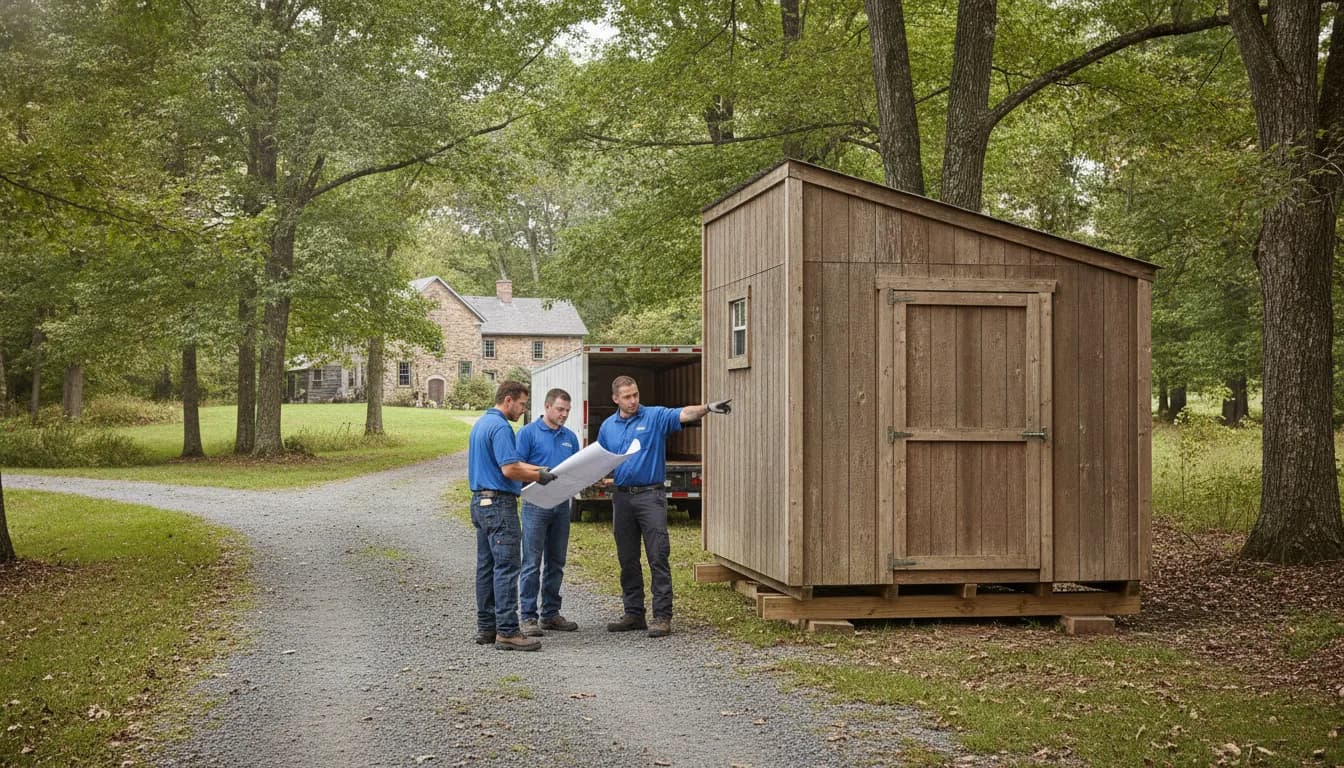
A storage shed may look portable, but moving one is not as simple as loading it onto a trailer. The building's condition, dimensions, support system, route, and destination all affect whether relocation is practical and safe. That matters especially in Hudson Falls and across Upstate New York, where uneven ground, narrow access, overhead lines, and seasonal mud can change the plan.
Call Legacy Structures at 518-544-2889 to discuss your shed move.
Learning how to move a storage shed starts with a feasibility check, not a lifting method. Inspect the structure for rot, insect damage, loose joints, and other weaknesses, then confirm its size, weight, support, and travel route. A qualified mover can help determine the right equipment and whether the shed should be relocated at all.
Before anyone plans the move, take an honest look at the building itself. A careful condition check can reveal whether the shed is sturdy enough for relocation, what preparation it may need, and when replacing it is the safer choice.
Can You Move Any Storage Shed? Start With a Condition Check
Before planning how to move a storage shed, determine whether the building can tolerate relocation at all. A practical assessment looks at its dimensions, construction, physical condition, support system, and the route between the current and future sites. Legacy Structures notes that these factors directly affect whether moving is practical, so a shed that appears portable may still require professional planning.
Inspect the building before choosing a method
Start with a careful walk-around, inside and out. Look for rot in the floor, walls, or framing, along with insect damage, loose or weakened joints, and areas where water has compromised the structure. These problems are not merely cosmetic. Rot, insect damage, and weakened joints can change the relocation method and the preparation required, according to this shed relocation assessment.
Pay particular attention to the lower structure and its support. Damaged skids, sleepers, blocks, or other supports may not carry the building evenly during movement. The support beneath the shed also matters at the destination. A gravel bed, simple wooden supports, or a concrete slab may each require a different preparation approach. The goal is a firm, level place for the building to rest, not a rushed lift onto an uncertain surface.
Size, construction, and access change the answer
Measure the building and note its construction, doors, attached features, and anything that could change its balance or clearance. Weight and size influence the equipment, people, and transportation logistics needed. Do not guess the weight or assume a pickup, trailer, rollers, or improvised lifting setup is adequate. Overlooking weight limits can lead to equipment failure, property damage, or personal injury.
Then inspect both routes. Overhead obstructions, uneven terrain, narrow gates, soft ground, and limited access can make one moving method impractical. A shed may be structurally sound yet impossible to move safely through the available path. Check the destination as carefully as the original site, including its ground conditions and support plan.
Stop DIY planning if you find significant rot, unstable framing, damaged supports, a large or awkward building, or a route with serious access hazards. A qualified mover can assess the structure and plan equipment and support around its actual condition. For guidance on the building and site, contact Legacy Structures before committing to a move.
Complete the condition assessment before choosing a moving method.
How to Move a Storage Shed Safely Through Your Property
Route planning starts before anyone tries to lift, roll, or transport the building. Walk the entire path from the shed's current location to its planned destination, and assess both ends as carefully as the space in between. A shed that appears movable in an open yard may become impractical at a gate, driveway, slope, narrow side yard, or wooded edge. Dimensions, construction, condition, and access all affect whether relocation is practical.
Measure the route, not just the shed
Record the shed's exterior width, height, and length, then compare those measurements with the narrowest parts of the route. Check gates, fence openings, corners, driveway edges, retaining walls, landscaping, and any place where equipment would need to turn. Look for uneven terrain, soft or disturbed ground, steep grades, and overhead branches. Overhead obstructions and limited access can change the moving method or make a route unsuitable, so do not rely on a quick visual estimate.
Overhead electrical conductors require particular caution. The safety guidance cited in the research requires a minimum 10-foot clearance from electrical conductors, subject to its stated exceptions. Treat that as a safety planning issue, not a measurement to work around casually. If the route passes near service lines, utility connections, or other hazards, stop and involve qualified help before scheduling the move. Never attempt to pull a structure beneath or around lines without a properly evaluated plan.
Prepare the destination before relocation
The destination needs suitable, firm support before the shed leaves its original position. Confirm where the building will sit, how it will be aligned, and whether the ground is level and stable enough for the planned support system. Portable buildings should be placed on appropriate above-ground support such as prepared gravel, sleepers, skids, or blocks, depending on the building and site. Cribbing and blocking should rest on level, firm support, and the moving structure's floor system must be supported correctly during the operation.
Utilities and attached features also belong on the route checklist. Arrange for electrical or water connections to be safely disconnected when applicable, and remove attached items that could catch, break, or shift. Before the move, use the guide to prepare your property for delivery to review access clearing, location selection, stable support, and placement planning. The same preparation principles apply to a relocated building, but relocation adds the risks of handling an existing structure.
Plan around conditions and equipment
Weather can change ground conditions quickly, especially in Upstate New York. Mud, thawing soil, standing water, or icy surfaces may make a planned route unsafe even when the measurements work on paper. Recheck the route close to moving day and postpone the operation if conditions undermine equipment stability or worker footing. The mover should also calculate the structure's weight and select equipment with an appropriate safety factor rather than guessing from its appearance. A qualified professional can evaluate the building, route, support, and equipment together before work begins.
What Equipment and Support Does Shed Relocation Require?
The equipment plan should follow the building assessment, not the other way around. A shed's dimensions, construction, condition, and access route all affect whether relocation is practical. Professional movers select lifting, support, and transport equipment after assessing the building and both sites. That assessment helps avoid equipment failure, property damage, and injuries.
Weight is especially important. The applicable safety guidance says to carefully compute the weight being moved and select equipment with a safety factor of five. Do not rely on an estimated weight or assume that a pickup, trailer, jack, or dolly is suitable for your shed. The right choice depends on the actual structure and the planned route. Review the cited moving-safety guidance for the underlying requirements.
| Planning consideration | Why it matters | Safe next step |
|---|---|---|
| Weight and equipment | Weight and size influence the equipment, manpower, and transportation logistics required. | Have a qualified mover assess the building and select equipment using a documented weight and appropriate safety margin. |
| Cribbing and blocking | Temporary supports must remain stable while the structure is raised, held, or moved. | Use level, firm support. Do not improvise a lifting setup or work beneath an unsupported building. |
| Floor-joist support | Concentrated or uneven support can stress the floor system during movement. | Confirm that all floor joists are firmly supported by properly arranged running or cross members. |
| Rollers and dollies | Wheeled equipment can shift if it is not controlled, blocked, or matched to the move. | Let the moving professional determine whether rollers, dollies, or powered equipment are appropriate, and how they will be secured. |
| Route clearance | Overhead conductors, uneven terrain, tight access points, and other obstructions can change the moving method. | Measure the complete route. Maintain at least 10 feet from electrical conductors unless a qualified professional confirms an applicable exception. |
Support details deserve particular attention. Safety guidance calls for cribbing and blocking to rest on a level, firm foundation. It also says floor joists must be firmly supported on running members or cross members attached to them. Timbers must be sound and appropriately sized, and load-distribution equipment may be needed when cross members are used. These are reasons to avoid treating shed relocation as a simple matter of placing a few rollers underneath the building.
Before scheduling the move, document the shed's condition, clear the route, and identify the destination support. Customers are responsible for site preparation, including access, ground conditions, and the placement area. If the building is damaged, unusually large, unstable, or difficult to access, arrange a professional assessment before choosing equipment.
Complete the route and support plan before the moving day.
A Safer Step-by-Step Shed Moving Plan
Moving a storage shed is a coordinated relocation, not simply a matter of pulling it across the yard. The building, its supports, the route, and the destination all need to be evaluated before anyone begins. Use this sequence as a planning framework, then have a qualified mover determine the safe method for your specific shed.
- Empty the shed and document its condition. Remove tools, equipment, shelving that is not secured, and other contents so the building is not carrying unnecessary weight. Photograph the interior and exterior, including doors, windows, siding, floor areas, skids, and any existing damage. Note signs of rot, insect damage, loose connections, or weakened joints. A shed's dimensions, construction, condition, and access route all affect whether moving it is practical.
- Disconnect applicable utilities and remove attached features. If the shed has electrical or water connections, arrange for them to be safely disconnected before relocation. Drain fluids from equipment that will be moved separately. Remove attached ramps, steps, awnings, shelving, or other features when appropriate, and label hardware so the pieces can be evaluated for reuse. Do not attempt utility disconnection unless you are qualified to do so.
- Inspect the building and measure the complete route. Record the shed's outside dimensions and check both the starting point and destination. Measure gates, driveways, turns, slopes, and clearance around trees, fences, buildings, and overhead conductors. Uneven terrain, limited access, and obstructions can change the moving method. Electrical hazards require special attention. Washington safety guidance calls for maintaining at least 10 feet of clearance from electrical conductors, subject to its stated exceptions.
- Prepare the destination before the shed leaves its original site. Clear the placement area and establish suitable, level, firm support. Address drainage, ground conditions, access, and the final orientation in advance. Customers are responsible for site preparation before delivery or relocation, so unresolved conditions can create a delay or an unsafe last-minute decision.
- Have a qualified mover select the equipment and method. The mover should evaluate the shed's weight, dimensions, support points, route, and destination before choosing equipment. The applicable safety guidance says weights should be carefully computed and equipment should provide an appropriate safety factor. The wrong equipment can damage the building or injure people. This is also the point to decide whether a controlled lift, rollers, dollies, trailer, or another method is suitable. Do not assume a pickup truck, improvised rollers, or household jacks are adequate.
- Complete the move as a controlled operation. Keep people clear of pinch points and the travel path, follow the mover's directions, and stop if the building shifts unexpectedly or the route changes. Lifting, temporary support, and lateral movement require care to prevent mishaps. The crew should use proper blocking and support rather than relying on unstable or makeshift arrangements.
- Re-level, inspect, and reconnect only after placement. Once the shed is positioned, check that it is level and fully supported, then inspect doors, windows, siding, floors, and connections for movement-related damage. Complete placement, leveling, anchoring, and final inspection as appropriate for the building and site. Legacy Structures includes site preparation guidance, placement, leveling, anchoring, and final inspection among its service support, which can help Hudson Falls and Upstate New York property owners plan the last stage safely.
A careful plan may show that relocation is workable, or that replacing the building is the more responsible choice. Either outcome is better than starting a move before the shed and route have been assessed.
When Moving an Existing Shed Is Not the Best Option
Learning how to move a storage shed also means recognizing when relocation is a poor fit. A building may be portable in principle, but its dimensions, construction, condition, and access route all affect whether moving it is practical. If inspection reveals serious rot, insect damage, weakened joints, or an unstable floor, shifting the structure can create more risk instead of solving the storage problem.
Access can be the deciding factor. A narrow gate, steep or uneven ground, low branches, overhead conductors, or a destination that cannot be prepared may make the route unsuitable for the equipment and support a move requires. Do not commit to a plan until the origin, route, and new placement area have been evaluated. Customers are responsible for site preparation, including the ground, access, and placement area before delivery or relocation.
Equipment uncertainty is another reason to pause. A shed should not be lifted, dragged, or rolled with improvised tools simply because it looks small from the outside. If the building's weight, support points, or structural condition cannot be established, a qualified mover should assess it. In some cases, selecting a new building is the more straightforward way to get a sound structure in a location that can be properly prepared.
Replacing the shed can also make sense when the existing layout no longer matches what you store. The Utility Shed Sizing Guide can help you choose the right shed size for equipment, tools, and future storage. For broader decisions about materials, access, site preparation, and styles, review the storage shed buying guide.
Legacy Structures offers utility sheds, backyard barns, dormers, and portable garages in multiple sizes and styles. Through its 3D builder, shoppers can select features such as size, siding, colors, doors, windows, lofts, shelving, and workbench space. You can explore storage shed options and compare a new building against the limitations of the one you have. The right choice depends on the structure's condition, the route, the destination, and whether the finished space will serve your needs.
How Hudson Falls Weather Changes Shed-Moving Plans
Weather is part of the moving plan in Hudson Falls and across the Adirondack region, not an afterthought. Snow, freeze, spring thaw, and wet ground can change how a route looks and whether the destination is ready. Before scheduling a relocation, look at the conditions along the full path, including the starting area, access drive, turns, and prepared support at the new site.
Snow and frozen ground
Snow can hide uneven ground, low branches, drainage issues, or obstacles that are easy to see in warmer weather. Frozen ground may appear firm, but conditions can change as temperatures rise. Clear the route well enough to inspect it rather than assuming a packed or snow-covered surface is suitable. Also account for reduced visibility and limited maneuvering room around banks of plowed snow.
Spring thaw and muddy access
Spring thaw deserves particular attention in Washington County. A driveway or yard that handled equipment during a dry season may become soft, rutted, or difficult to cross. Moving too soon can create access problems and leave the destination support uneven. Check whether the route and placement area remain firm after rain and thaw, and be ready to adjust the schedule if the site is not prepared.
Choosing a practical season
Seasonal timing depends on the specific property, the building, and the mover's assessment. Fall may be a useful time to prepare a site before winter storage, while winter can be a good period to plan a spring installation or relocation. That does not make any season automatically suitable. Confirm ground conditions, overhead clearance, utilities, and destination support before committing to a date.
For a new placement or a relocation, our guide explains how to prepare your property for delivery, including access and site considerations. Local planning with Legacy Structures in Hudson Falls can help identify weather-related questions before the building is scheduled to move.
Call Legacy Structures at 518-544-2889 to discuss your shed relocation plan.
Frequently Asked Questions
Can I move a storage shed myself?
Sometimes, but not every shed is a safe DIY project. A small, sound building with straightforward access may be manageable with the right plan, while a larger, damaged, unstable, or difficult-to-access shed calls for qualified help. Improvised lifting or hauling equipment can damage the building and put people or property at risk.
How do I know if a shed can be moved?
Start with its condition, dimensions, construction, support, and route. Look for rot, insect damage, weakened joints, or other movement-sensitive problems. Then check the ground, gates, turns, slopes, overhead obstructions, and destination support. These details determine whether relocation is practical and what preparation it requires.
What should I check before moving a shed?
Empty the building and remove or secure attached features. Disconnect electrical or water connections through the appropriate professional when applicable. Measure the full route, identify overhead conductors and tight access points, and prepare a level, firm destination supported by suitable skids, sleepers, a gravel pad, or blocks. Do not begin until the moving plan and equipment match the building.
Should I move my existing shed or replace it?
Compare the shed's condition and relocation requirements with what you need at the new site. If damage, access limitations, or extensive preparation make the move impractical, a new building may provide a clearer path. Legacy Structures offers storage sheds in multiple styles and sizes. So Hudson Falls and Upstate New York shoppers can compare a new fit with relocation before making a decision.
Ready to Talk Through Your Shed Plan?
Moving a shed safely depends on its condition, the route, and the destination site. If you are in Hudson Falls or elsewhere in Upstate New York, Legacy Structures can help you think through whether relocating your current building or choosing a new storage shed makes more sense.
Call Legacy Structures at 518-544-2889 to discuss your plan and explore the next step.