
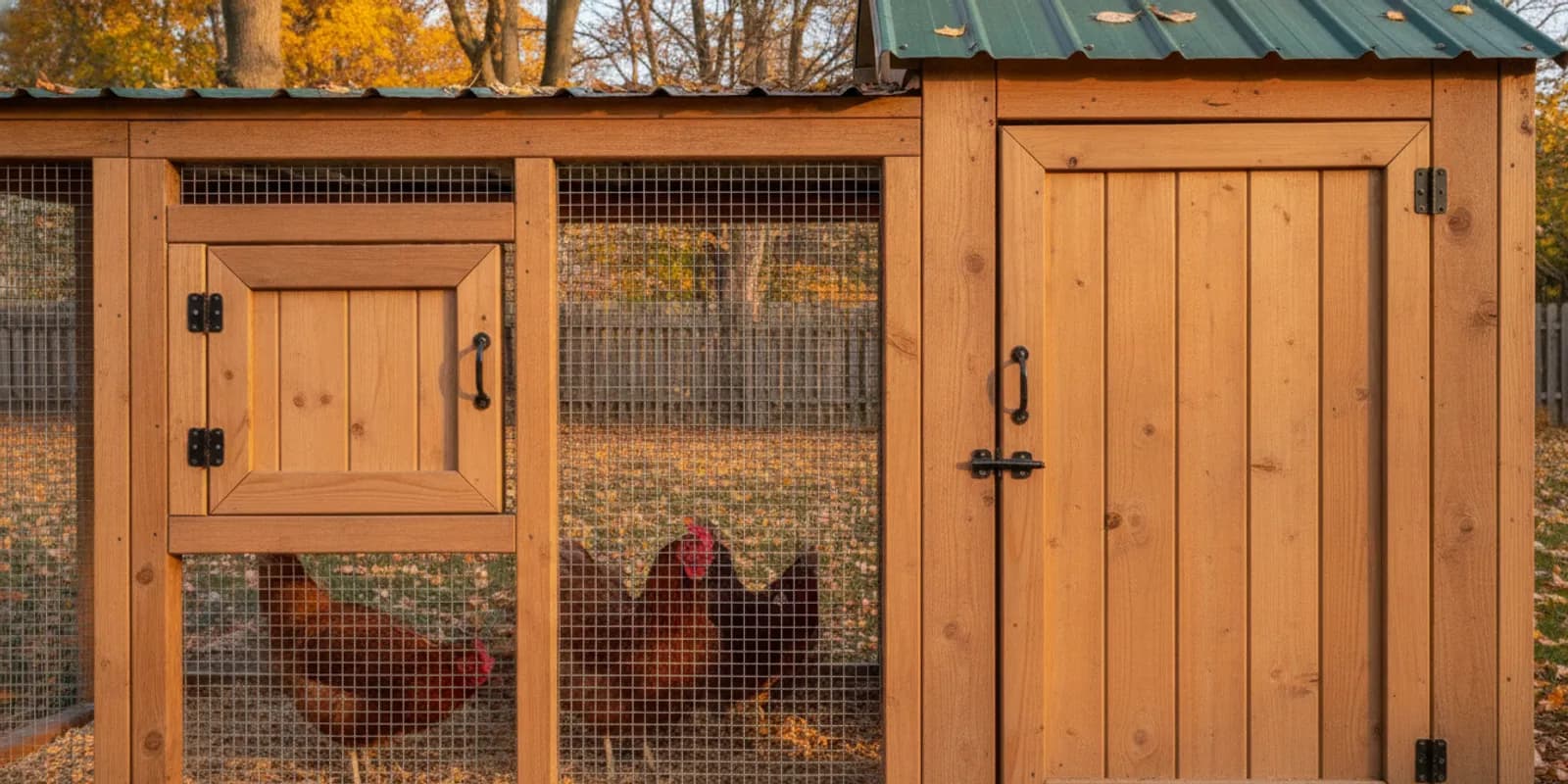
If you are figuring out how to build a chicken coop door, start with the birds, the opening, and the way you will use the coop every day. A good door gives hens a clear route between shelter and run, closes securely at night, and still works when rain, mud, or winter weather arrive.
Talk with Legacy Structures about a chicken coop
The simplest useful plan is usually a small pop door for the flock plus a separate, larger access door for people. The pop door should fit the largest bird comfortably, slide or swing without sticking, and close against a solid frame. Choose the style before cutting materials: a door that looks easy to build can become frustrating if it is hard to reach, clean, or secure.
What should a chicken coop door do?
A coop door is more than an opening in a wall. It is part of the flock’s daily route and one of the points where weather and unwanted animals may get inside. Before building, answer four questions: who uses the opening, when will it be opened, what space is available, and how will it be secured?
- Allow easy movement. The opening should not force birds to squeeze, jump awkwardly, or crowd against one another. Measure the largest bird in your flock and leave practical clearance around it.
- Close reliably. The door should meet its frame evenly and stay closed when you expect it to. A latch should be simple for you to operate but not rely on friction or a loose hook alone.
- Work from the outside. You will need to open, close, and inspect it in everyday conditions. Consider whether you can reach the latch without stepping into mud, snow, or the run.
- Keep ventilation separate. A pop door is not a substitute for planned ventilation. Provide suitable airflow elsewhere in the coop without leaving a large, unprotected gap at bird level.
Think about the human route, too. If you need to collect eggs, add bedding, or clean inside, a small chicken opening is not enough. A person-sized access door makes those jobs possible without using the flock’s doorway as a service entrance. For inspiration on the building itself, review the available chicken coops from Legacy Structures and consider which access points match your routine.
Which door style fits your coop?
Most coop doors fall into a few practical types. A sliding pop door moves vertically in guides; a hinged door swings open; and a ramp or threshold helps birds cross the sill. The best option depends on the wall layout, exterior clearance, and your ability to keep moving parts clean.
| Door style | Useful when | Plan for | Possible drawback |
|---|---|---|---|
| Vertical sliding pop door | You want a compact flock opening and have clear wall space above it | Parallel guides, a handle or pull, and a way to hold it fully open or closed | Dirt or swelling can make a close-fitting panel bind |
| Outward-swinging hinged pop door | You have unobstructed space outside the wall | Weather-resistant hinges, a stop, and a secure latch | Snow, equipment, or the run may block its swing |
| Inward-swinging hinged pop door | The outside approach is tight and the coop interior allows a full swing | Room inside and a design that does not interfere with birds or bedding | It can take up valuable interior space |
| Large human access door | You need to enter for cleaning, inspection, or routine care | A clear approach, sturdy frame, and secure people-sized latch | It needs its own weather and security planning |
For many small coops, the sliding pop door is a straightforward starting point because it does not need a wide swing area. A hinged door can be equally workable when there is room for it to open and the hinge side is protected from damage. Avoid choosing solely by appearance. A mechanism that is awkward to reach or likely to jam will be less useful than a simple design you can operate consistently.
Where should you place and size the opening?
Before marking the wall, walk through the birds’ route from the coop interior to the run. Check the location from both sides. Inside, the opening should not lead straight into a crowded corner, sit behind a roost, or conflict with a feeder. Outside, make sure the door can open fully and that its landing area does not end in a puddle or against an obstacle. A convenient route can reduce crowding when several birds move through around the same time.
Use the largest bird as your sizing reference, then consider the flock as a whole. A passage that is technically wide enough may still be difficult if a bird must turn immediately or step over a tall sill. Sketch the opening and the panel before cutting. Include the frame, guides or hinges, and the panel’s full travel in the drawing. For a slider, mark the vertical space the panel needs above the opening. For a hinged door, trace the swing arc and check for nearby walls, the run, or stored tools.
Also think about the height of the threshold. A raised edge can help define the opening, but an abrupt step may discourage smaller birds or collect litter. A low, stable ramp can bridge the transition, provided it does not become slick or obstruct the door. These small layout decisions are easier to change on paper than after the wall has been cut.
How do you build a chicken coop door step by step?
These steps describe a basic, manually operated pop door. Adapt the dimensions to your birds and the coop wall. Use materials appropriate for outdoor exposure, and follow the tool and fastener manufacturers’ safety directions.
- Pick the location. Choose a wall with a direct route to the run, away from a spot where water regularly collects. Check that the proposed opening will not cut through a framing member or interfere with another door, roost, or interior feature. Confirm that the birds can approach it without a sharp turn or a high obstacle.
- Measure the flock and opening. Measure the largest bird in its normal standing posture. Allow enough width and height for it to pass comfortably, with some room for feathers and ordinary variation in movement. Consider the smallest birds as well: an opening that is too tall can be harder for them to use. Mark a rectangle on the wall and review it from both sides before cutting.
- Make a sound, square opening. Check the wall construction and cut carefully within the marked outline. Remove rough splinters, then frame the edges so the wall around the opening stays neat and the door has a firm surface to meet. The size of this frame depends on the coop’s construction; do not remove or weaken structural framing to fit a preferred door size.
- Build the panel. Cut a panel that covers the opening with enough overlap to meet the frame on every side. It should be light enough for you to lift comfortably, yet rigid enough to remain flat. Sand rough edges. If using wood, protect exposed surfaces with a suitable finish and allow it to dry fully before birds have access. Avoid leaving sharp fastener points or splintered edges.
- Add guides or hinges. For a sliding door, attach straight guides on both sides of the opening. Leave a small, even clearance so the panel moves freely without a large gap. For a hinged design, align the hinges so the panel does not sag or scrape. Test the motion by hand before adding a handle or final latch.
- Fit the latch. Add a latch that holds the panel firmly shut and can be checked at a glance. Position it where you can reach it without awkward bending or reaching through the run. If you want the door to stay open during the day, create a deliberate way to secure it in that position rather than leaning it against the wall.
- Finish the threshold and route. Keep the lower edge clear enough that litter, mud, and small debris do not continually wedge under the panel. A low, stable threshold or ramp can help birds move through the opening. Avoid a steep, slippery surface and check that the transition does not create a trip or snag point.
- Test it in real use. Open and close the door several times. Check for rubbing, loose fasteners, sharp edges, light showing through an unintended gap, and a latch that can be knocked open. Watch the flock use the opening and make adjustments if birds hesitate or bunch up.
Keep the door mechanism serviceable. A simple panel that can be removed or adjusted is easier to maintain than an elaborate assembly with hidden parts. If the coop wall is already built, inspect its framing before cutting. When a change would compromise the wall or you are unsure how it is assembled, ask a qualified builder rather than guessing.
How can you make the door secure without making it difficult to use?
Security starts with fit. A door that sits flat against a solid frame leaves fewer obvious gaps than one that twists or hangs loosely. Check the corners, bottom edge, guides, and hinge side. A latch should hold the door in place against routine bumps, and the surrounding wood should be strong enough that the latch cannot simply pull free.
- Use a positive latch instead of relying on a panel’s weight or a loose friction fit.
- Keep the latch and fasteners accessible for inspection. Tighten loose hardware and replace parts that bend or corrode.
- Close openings that are not part of the intended design, while keeping planned ventilation openings distinct from the bird door.
- Check the door after storms, cleaning, or any change that could shift the panel or guides.
- Make a habit of confirming the door is closed at the time you expect the flock to be inside.
Do not assume that a small opening or a heavy door is secure by itself. The whole assembly matters: the panel, its guides or hinges, its frame, and the latch. A wooden door can also change shape with moisture, so leave the clearance needed for smooth movement and check it periodically. These practical checks are especially useful when choosing among available chicken coop designs, since the wall layout and access arrangement can affect the door you can install.
How do you test and maintain the door?
Test a new door in several stages instead of checking it only once at installation. First, move the panel through its full travel slowly and look for contact at the top, bottom, and sides. Then operate the latch repeatedly from the position where you will normally stand. A latch that works only when you hold the panel at an awkward angle may become frustrating during daily use.
Next, watch the flock approach and pass through. Notice whether birds hesitate at the sill, turn sideways, or bunch up because the route is narrow or obstructed. If they do, check the approach, ramp, and opening rather than assuming they will adapt. Clear bedding and dirt from the threshold, then repeat the test. Confirm that a sliding panel stays aligned in its guides, or that a hinged panel does not sag and scrape as it moves.
Make a simple inspection routine part of regular coop care. Look for loose screws, a bent latch, a rough edge, cracked or swollen wood, and debris that slows the mechanism. After wet weather or a change in temperature, try opening and closing the door again. If it sticks, find the cause and correct it; forcing it can damage the panel or make the opening harder to secure. These checks take little time and help catch small fit problems before the door becomes unreliable.
What changes in Upstate New York weather?
In the Hudson Falls area, the door may face wet conditions, freeze-thaw cycles, and snow that gets pushed against the coop. Plan for the route and moving parts, not just the panel. A door that slides perfectly on a dry day may drag if debris gathers in its guides; a swing door may be blocked by snow or a stored item.
- Keep the mechanism clear. Put guides where you can inspect and clean them. Remove packed dirt and bedding instead of forcing a stuck panel.
- Think about snow clearance. Consider where snow is likely to accumulate and where you can stand to operate the latch. Keep the path to the door manageable.
- Protect exposed materials. Use suitable exterior materials and finishes, and check that water is not continually running into the frame.
- Test after a weather change. Once conditions shift, verify that the door still opens fully, closes flush, and latches as intended.
Do not solve a draft by leaving the pop door partly open or blocking the coop’s planned airflow. The flock needs a secure entry and a suitable ventilation plan; those are separate design questions. A door that opens to an outdoor run also does not make that run weatherproof or predator-proof.
What should you check before building or buying a coop?
First, check local requirements for your property. Rules can differ between municipalities and may distinguish a coop, run, setback, or number of birds. As one example of local variation—not a rule for New York—this City of Farmington council packet refers to chicken coops and runs in its municipal discussion. Ask your own municipality what applies before you cut into a wall or place a building.
Next, decide whether a door project is a good fit for the structure. A new coop gives you more freedom to plan the pop door, people door, run connection, and cleaning access together. On an existing coop, the wall construction and the location of framing can limit your options. If you are still comparing structures, the current building inventory is a useful place to review available options, and the Legacy Structures team can help you discuss the building and its intended use.
For a portable building, ask how the door and run connection work with the unit’s layout before you commit to a modification. Do not bury or embed the base of a portable coop; it should sit on a suitable prepared surface and remain movable or re-sitable. Confirm what adjustments are appropriate for the specific structure rather than assuming every wall can be cut in the same way.
Call Legacy Structures at 518-544-2889 to discuss chicken coop options and access needs.
Frequently Asked Questions
How big should a chicken coop pop door be?
There is no single opening size that suits every flock. Measure the largest bird and provide enough clearance for it to pass without squeezing, while keeping the opening appropriate for the smallest birds. Consider the threshold and route as well as the cutout dimensions.
Is a sliding or hinged coop door better?
Neither is always better. A sliding door needs guides that stay clean and straight, while a hinged door needs enough swing space and hardware that will not sag. Choose the style that fits the wall, outside approach, and your ability to operate and maintain it.
Should the chicken door provide ventilation?
No. Treat the pop door as an entry, and plan ventilation separately. Do not leave the bird opening partly open to address a ventilation concern; instead, review the coop’s airflow design and keep openings protected as appropriate.
Can I cut a pop door into an existing coop?
Possibly, but inspect the wall construction first. The opening needs a sound frame and should not cut through or weaken structural framing. If you cannot tell how the wall is built, get qualified help before cutting.
Do I need to check local rules before building a coop door?
Check municipal requirements before making changes or placing a coop. Rules may address the coop, run, setbacks, or flock separately, and a rule from another city does not establish what applies to your property.
A well-planned chicken coop door is sized for the birds, easy for you to operate, and simple to inspect and maintain. Take time to test the opening and latch before relying on them as part of the flock’s daily routine.