A storage shed can look like a simple weekend project, but the permit answer depends on more than the building's size. New York has a narrow state building-permit exemption for some one-story, detached storage sheds associated with one- or two-family homes, yet local zoning and property-specific rules still matter.
In New York, do you need a permit to build a storage shed? You may not need a building permit if the shed is one story, detached, used for storage, tied to a qualifying residential property, and no larger than 144 square feet of gross floor area. That exemption does not authorize work that violates other applicable codes, and it does not replace a conversation with your local building department. Read the New York regulation before relying on it.
For homeowners in Hudson Falls and across Upstate New York, the safest first step is to separate the statewide rule from the local review. Start by checking what New York allows, then confirm how your municipality applies zoning, setbacks, and other site requirements before ordering or placing a shed.
Do You Need a Permit to Build a Storage Shed in New York?
New York provides a building-permit exemption for a specific type of small storage shed. Under the state Uniform Code, a one-story, detached structure associated with a one- or two-family dwelling, or with multiple single-family dwellings such as townhouses, may qualify when its gross floor area does not exceed 144 square feet. The listed uses include tool and storage sheds, playhouses, and similar structures. You can review the state language in New York's Uniform Code regulations.
That 144-square-foot figure refers to gross floor area, not a general promise that any shed under that size is exempt everywhere. The structure must also fit the regulation's other conditions. The exemption is framed around a detached, one-story building in a specified residential setting, so the answer may differ for a commercial property, a different property type, or a structure used for something beyond ordinary storage or a similar listed use.
What the exemption does not cover
A building-permit exemption is not a waiver of every rule that may apply to the project. New York's regulation states that an exemption from obtaining a building permit is not authorization to perform work in violation of the Codes. Local governments generally administer and enforce the Uniform Code and Energy Code, so the department serving your property remains an important source for project-specific guidance.
In practical terms, do not treat the state exemption as a complete zoning or site-approval answer. Before ordering or placing a shed, ask the appropriate local department whether other requirements apply to the property, location, use, or placement. A gravel pad, portable design, or smaller footprint does not by itself establish that every local obligation has been satisfied.
If a permit is required, New York rules say work may not begin until the permit has been obtained. The department examines the application for compliance with applicable Code requirements. Issuance depends on a complete application, required fees, and a determination that the proposed work conforms to the Codes. The state rule can identify the framework, but your local department must clarify how it applies to your specific property.
| Planning question | What the state rule tells you | What to confirm locally |
|---|---|---|
| Size | A specific exemption reaches up to 144 square feet of gross floor area. | How the department measures the area and whether another local rule applies. |
| Structure | The exemption is for a one-story, detached structure. | Height, setbacks, placement, and site conditions. |
| Property and use | The exemption is tied to qualifying residential settings and storage or similar uses. | Whether your property type, intended use, utilities, or zoning require review. |
Why Local Zoning Still Matters in Hudson Falls and Upstate New York
New York's building-permit rules are only one part of the answer to “do you need a permit to build a storage shed.” Even when a shed appears to fit a state building-permit exemption, the placement and use of the structure may still be subject to local requirements. A permit exemption is not permission to ignore applicable codes. New York's regulation expressly says that an exemption from obtaining a building permit does not authorize work that violates the Codes.
That distinction matters because building-code review and zoning review answer different questions. Building-code review generally focuses on how a structure is built. Zoning review can address where it sits, how close it is to property lines or roads, and whether the proposed use fits the property. Local rules may also affect height, access, utilities, drainage, or other site conditions. If the property is in a floodplain, near a protected area, or subject to another site-specific review, those factors can change the steps required before installation.
Hudson Falls requirements are not a statewide rule
New York's Department of State explains that local governments generally administer and enforce the Uniform Code and Energy Code. The responsible department can also request information it considers necessary to determine whether proposed work conforms to the Codes. In practice, that means the answer can differ between Hudson Falls, a nearby town, and another Upstate community. There is no universal local square-footage threshold that safely answers the permit question for every property.
For Hudson Falls, the village's Code Enforcement information says that most sheds need a permit and directs property owners to verify requirements with Code Enforcement. Treat that as the practical starting point, not as a substitute for a conversation about your specific parcel. Before ordering, ask which department has jurisdiction and whether your proposed size, location, foundation or base, intended use, and utilities require approval.
Remember private and property-specific rules
If you belong to a homeowners association, review its rules as well. An HOA may regulate whether an accessory building is allowed, along with its appearance, size, or location. Its setback requirement may be more restrictive than the municipality's. A local permit also may not resolve private deed restrictions or site-specific concerns.
Legacy Structures can help you think through building size, configuration, delivery access, and site preparation, but the local code official determines which approvals apply. Confirm the requirements in writing before you finalize the site or schedule delivery.
What Should You Check Before Ordering a Shed?
Before you choose a model or schedule delivery, gather the details a local building or zoning department will use to evaluate your project. The answer to “do you need a permit to build a storage shed” can depend on more than the shed's advertised size. Property type, intended use, placement, utilities, and local procedures may all matter.
- Confirm the municipality and property type. Identify the town, village, or city where the shed will sit. Then confirm whether the property is a one- or two-family home, townhouse, rental, farm, or business site. New York's state exemption is written for specific residential settings, so do not assume it applies to every property.
- Describe the intended use. Will the building hold garden tools, lawn equipment, seasonal items, or something else? Explain the use plainly. A storage shed, workshop, agricultural building, or structure with living or commercial use may be reviewed differently.
- Calculate gross floor area, height, and stories. Measure the planned footprint and confirm the gross floor area, not just the interior storage space. Also record the overall height and whether the structure is detached and one story. New York's cited exemption references a one-story detached structure and a gross floor area of no more than 144 square feet, but the local department must determine how the rule applies to your project.
- Mark the proposed placement and setbacks. Sketch the shed's location in relation to property lines, the house, driveway, road, rights of way, drainage areas, and other structures. Ask which setbacks, easements, floodplain rules, or site restrictions apply. A building-permit exemption does not authorize work that violates applicable codes. Measure your yard before building so the planned footprint and access route are realistic.
- List planned utilities and site work. Tell the department if you want electricity, plumbing, lighting, or other connections. Ask whether those improvements need separate permits or inspections. Also clarify the acceptable site preparation and anchoring requirements before ordering.
- Check HOA or property restrictions. If your neighborhood has an HOA, review its rules for shed size, appearance, location, and approval. Those private rules can be stricter than municipal requirements and may apply even when a building permit is not required.
- Verify access and local forms. Check whether the delivery path can accommodate the shed, truck, and equipment without crossing a neighbor's property. Finally, ask the local department whether you need a zoning review, site plan, permit application, or other form, and how it must be submitted. For broader planning help, prepare your Upstate New York shed site before committing to a configuration.
Keep the department's response with your project records, including the official contact, date, and any conditions. Once those requirements are clear, you can explore storage shed options with fewer surprises. Final approval or exemption decisions belong to the authority serving your property.
What Documents Do You Need for a Shed Permit?
If your local department says a permit is required, gather the application materials before you order or schedule installation. The exact packet varies by municipality, but New York's building-permit rules provide a useful outline for the information an application may need.
Basic property and ownership information
Start with the people and property identified on the application. The New York regulation says the application must be signed by the owner of the structure and, when different, the owner of the real property. It also calls for the street address and tax map number of the affected structure or property. If you are a renter, buying for someone else, or working with a property owner, confirm in advance who must sign and whether written authorization is required.
You will also need a clear description of the project. Include where the shed will be located, what it will be used for, and the nature, extent, and scope of the proposed work. Be ready to identify the building's overall dimensions, story count, doors, windows, and any planned electrical or plumbing work. Do not assume that a portable building, gravel pad, or movable placement removes local requirements.
Drawings, specifications, and a site plan
Many applications require construction documents, including drawings and specifications. The state rule says those documents must be drawn to scale. A practical packet may therefore include a dimensioned floor plan, elevations showing the exterior, building specifications, and a site plan showing the property lines, existing structures, proposed shed location, and distances requested by the department. Your local office may provide a checklist or require a particular format, so use its current forms rather than relying on an old application or a generic online template.
New York's regulation also allows the department to request additional submittal documents, information, or documentation needed to determine whether the proposal conforms to the Codes. The department may consider climatic and geographic design criteria, which can be especially relevant when planning an outdoor structure in Upstate New York. Review the current requirements with the authority that administers permits for your property.
Fees, review, and timing
A permit is not issued simply because an application was submitted. The department examines the proposal for applicable code compliance. Under the New York rule, issuance requires a complete application, payment of the appropriate fees, and a determination that the work conforms to the Codes. The department may also attach special conditions.
Because each municipality controls its submission process and may request different materials, do not rely on a guaranteed approval date or assume every town accepts applications the same way. Ask whether filing is online, by mail, or in person, what fees apply, and whether any additional review is needed. If a permit is required, New York law says work should not begin until the permit has been obtained. See the official New York permit regulation and confirm the current checklist with your local building department.
How Can You Plan a Permitted Shed With Legacy Structures?
Once you know the permit and zoning questions for your property, you can plan the building itself with fewer surprises. Legacy Structures is a family-owned portable-building dealer in Hudson Falls, serving homeowners and property owners across the Upstate New York region. Our role is to help you think through the building, delivery, and site requirements. Your town or city building department remains the authority on whether a permit is required and what documentation applies.
Start by confirming the intended location, approximate dimensions, access route, and use of the shed. It also helps to measure your yard before building, especially if setbacks, slopes, overhead branches, driveways, or property lines could affect placement. If you are still comparing styles and features, our 3D builder can help you review size, siding, colors, doors, windows, and add-ons. It is a configuration tool, not a permit checker, and it cannot determine whether your municipality will approve a particular placement.
Plan the site and delivery separately from the building
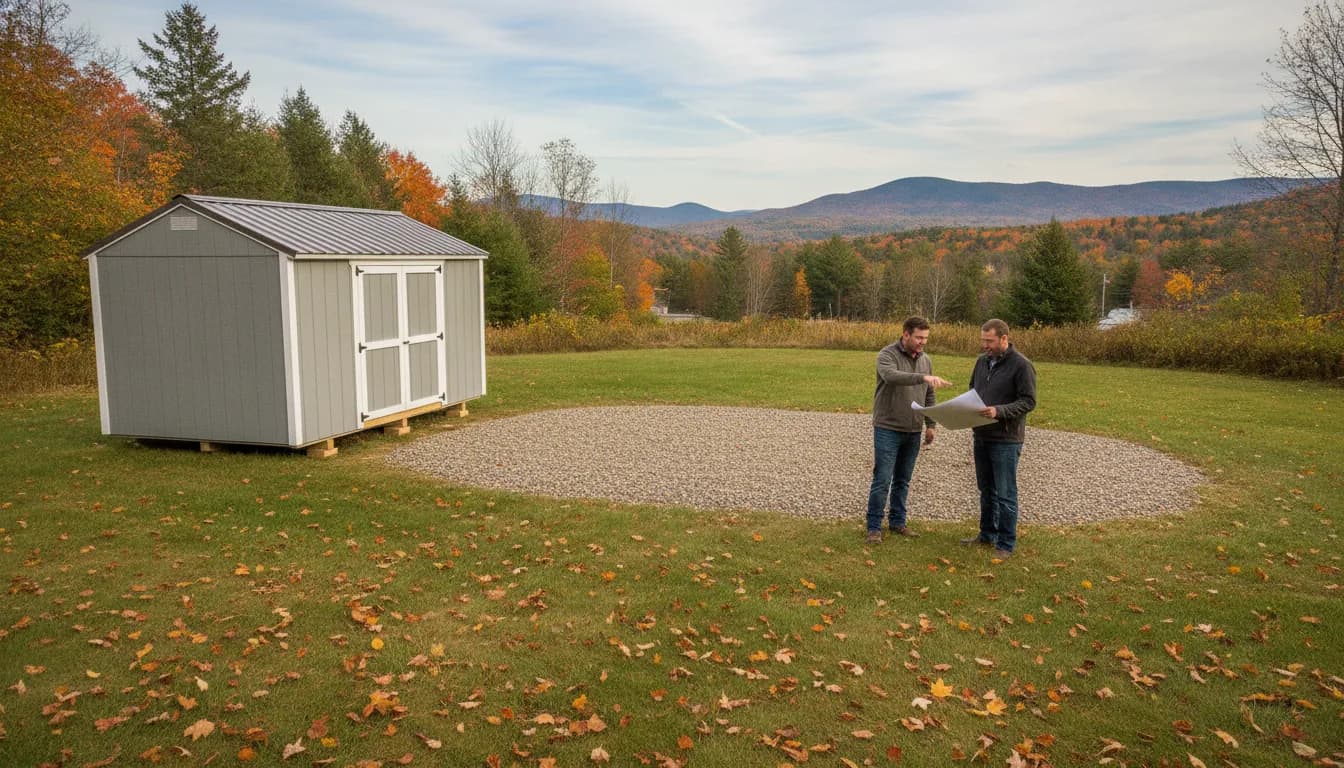
Site preparation is the buyer's responsibility. Before ordering, plan for a suitable, accessible area and confirm what preparation your property needs. A shed sits on or above the ground, so do not assume that a gravel pad, blocks, or portability removes a permit or zoning requirement. Those questions depend on the property and local rules.
When installation is included, leveling can accommodate up to 2 feet, and anchoring follows local code requirements. That service does not transfer responsibility for confirming local approvals. Ask the building department about permits, setbacks, utilities, drainage, and any site-specific restrictions before you finalize the location. You can also prepare your Upstate New York shed site with delivery access and placement in mind.
After the local review is clear, you can explore storage shed options that fit the approved plan. Keeping the local requirements and the building configuration aligned makes the next conversation more productive and helps avoid choosing a size or feature set that will not work on your property.
Have questions about planning a storage shed? Call Legacy Structures at 518-544-2889 before you order.
What Happens If You Skip the Permit Check?
Skipping the permit check can create uncertainty at the point when your shed is already ordered, delivered, or placed. The issue is not simply whether a small structure looks portable. New York's rules distinguish qualifying building-permit exemptions from permission to ignore other applicable requirements. An exemption does not authorize work that violates the Codes, and work that does require a building permit should not begin until the permit is obtained. Read the New York permit regulation for the governing language.
That is why the safest practical step is to pause ordering or installation until the appropriate local authority confirms what applies to your property. Local governments generally administer and enforce New York's Uniform Code, so the right contact may be your town, city, or county building department. Ask for a written response when possible, especially if the answer depends on the shed's size, use, location, or property type.
Keep the questions separate
- Building permit: Ask whether the structure and proposed work require a building permit. If a permit is required, the department examines the application for code compliance, completeness, fees, and any necessary conditions.
- Zoning and placement: Ask about setbacks from property lines, roads, rights of way, protected areas, and other structures. A building-permit exemption does not automatically settle zoning questions.
- HOA rules: If your property is governed by an association, check its rules for size, appearance, placement, and approval requirements separately from municipal review.
- Utilities: If you plan to add electricity or plumbing, ask whether that work requires its own approval. Do not assume a storage-only plan covers later utility work.
Save the department's email, notes from phone calls, application materials, site measurements, and any conditions they provide. Keep the building dimensions and intended use consistent across those records. Once the requirements are clear, you can explore storage shed options with fewer surprises. If you still have questions about your situation, the FAQ below covers common permit and local-review questions.
Frequently Asked Questions
Do you need a permit to build a storage shed in New York?
It depends on the shed and the property. New York provides a building-permit exemption for a one-story, detached tool or storage shed associated with a one- or two-family dwelling when its gross floor area is no more than 144 square feet. The exemption does not authorize work that violates other applicable codes. New York Department of State guidance is the best starting point.
Does a shed under 144 square feet always avoid permits in Hudson Falls?
No. The state exemption is not a universal answer to local requirements. Local governments generally administer and enforce New York's Uniform Code, and local zoning, setbacks, property conditions, or other rules may still apply. Before ordering, ask the appropriate Hudson Falls or local code-enforcement office to confirm the requirements for your parcel.
What size shed requires a permit in New York?
There is no single answer for every property type and situation. The state rule identifies 144 square feet of gross floor area as the upper limit for a specific exemption, and that exemption also requires the structure to be one-story, detached, and associated with a qualifying residential dwelling. A larger shed, a different use, or a different property setting may require review. The regulation explains the scope.
Can utilities change the permit requirements for a storage shed?
They can. Adding electrical, plumbing, or another utility may create additional review requirements, even when the building itself appears small. Ask your local building or zoning department before planning utility connections, and request its current application list rather than relying on a general size rule.
What happens if you skip the permit check?
If a permit is required, New York rules say work cannot begin until the permit has been obtained. Pausing to verify the requirements before delivery or installation can help you avoid an incorrectly sited or improperly documented project. Confirm the process with your local department.
Ready to plan your storage shed?
Local permit requirements can depend on your property, shed details, and the authority reviewing the project. Before ordering, call Legacy Structures at 518-544-2889 to review your storage shed plan. Then explore storage shed options that fit your space and intended use.