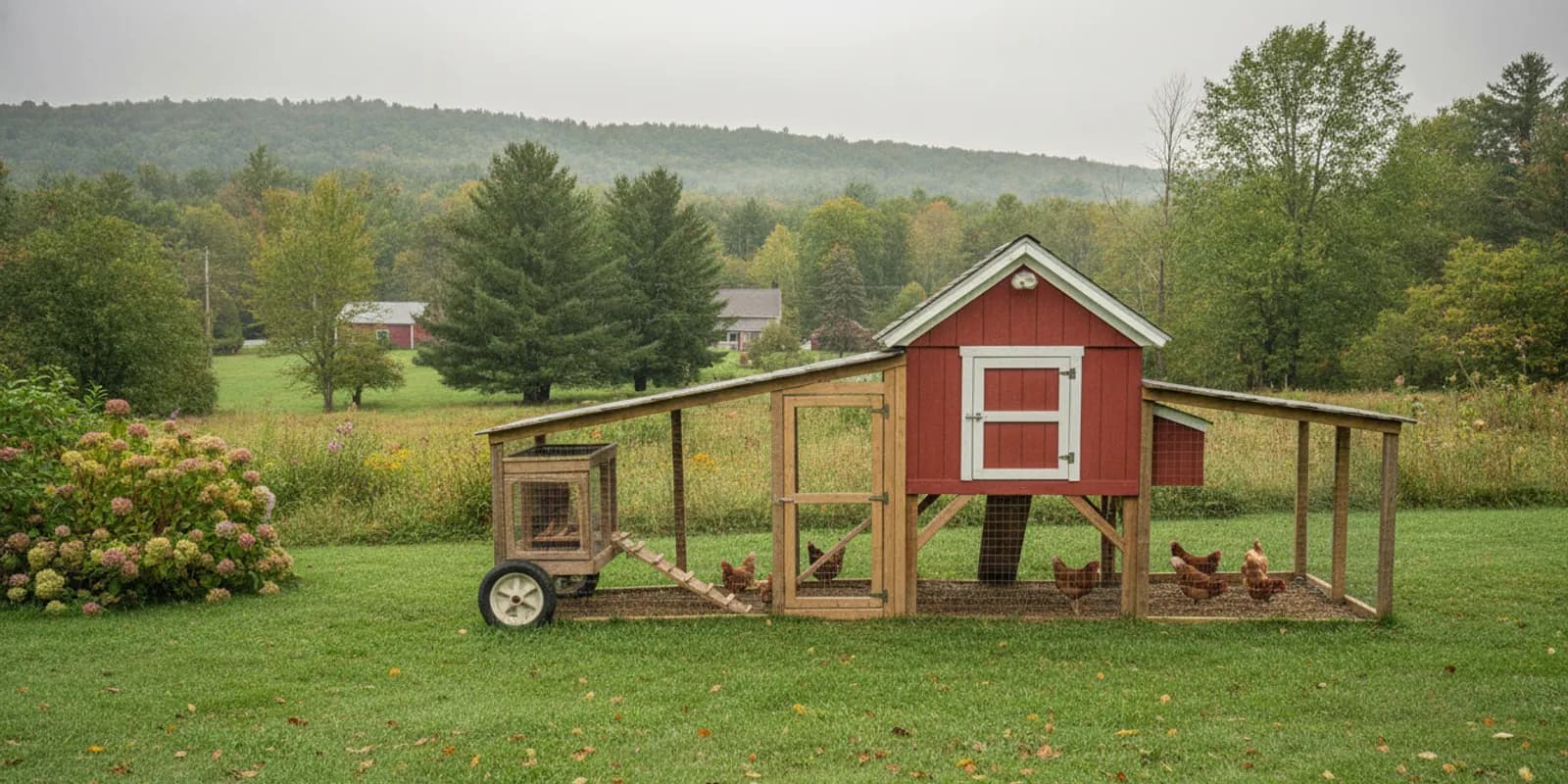
A chicken tractor is a movable enclosure for poultry, usually combining a protected shelter with an attached run. A stationary coop stays in one location and may have a fixed or separately managed outdoor run. The right choice depends less on which design sounds simpler and more on how often you can move it, what protection your flock needs, and how your yard handles snow and wet ground.
Talk with Legacy Structures about your coop plans
For a small flock with a suitable yard and a keeper who can move the enclosure regularly, a chicken tractor can offer flexible access to fresh ground. For a flock that needs a dependable shelter through cold, snowy weather, or for an owner who does not want moving the enclosure to become a daily task, a stationary coop with a well-planned run may be more practical. Before deciding, compare the whole routine: nighttime security, cleaning, feed and water, winter access, and the space available on your property.
What does “chicken tractor” mean?
The term chicken tractor usually describes a portable poultry pen that can be shifted to a new patch of ground. Some are lightweight frames with mesh sides and a small sheltered area. Others are larger, more substantial structures. The shared idea is mobility: the enclosure is moved so birds can use a different area rather than staying in the same run indefinitely.
“Tractor” does not necessarily mean a powered vehicle or a building that can be moved easily by one person. A larger, heavier unit might need wheels, a hitch, equipment, or help to relocate. A design that is technically movable but difficult to move in practice can end up functioning like a stationary coop.
A stationary coop, by contrast, is set up for ongoing use in one location. It can have an attached run, a separate run, or supervised access to a larger yard. Its shelter and layout are planned around routine care and conditions at that site. The building should sit on a suitable prepared surface, such as a level gravel pad, blocks, or a deck, rather than being sunk into the ground.
Both arrangements can work. Neither label alone guarantees flock safety, ease of cleaning, or good winter performance. Those outcomes depend on the actual structure, materials, openings, site, flock size, and daily care.
Which setup is better for your daily routine?
Start with an honest look at the work you will do, not the work you hope you might do. A chicken tractor can require frequent checks and regular moves. A stationary setup concentrates the work at one site, but that site needs to be laid out well and kept in good condition.
- Moving the enclosure: Can you shift it without straining, and is there a clear path across the yard? Consider gates, slopes, trees, soft ground, snow, and the size and weight of the loaded structure.
- Opening and closing: Can you reliably secure the flock at night and let it out when appropriate? Think through the routine on busy days, not only when you have extra time.
- Cleaning: Can you reach the interior, remove soiled bedding, and clean feeders and waterers without awkward lifting or crawling?
- Feed and water: Are supplies easy to refill and protected from weather and contamination? A mobile plan may mean carrying supplies farther or relocating them with the enclosure.
- Ground conditions: Will the chosen location become muddy, uneven, or difficult to cross? A portable setup still needs a manageable route and usable ground.
Try mapping one ordinary week. Write down who will move the unit, when it will be moved, how water and feed will be replenished, and what happens if the usual caretaker is away. If the plan only works when one person has spare time every day, revise it before buying or building.
How do the two options compare?
This table compares common tradeoffs, not guarantees. Designs vary, and a well-planned stationary coop can be paired with a moveable run, just as a tractor can have different shelter and access arrangements.
| Consideration | Chicken tractor | Stationary coop |
|---|---|---|
| Primary advantage | Can be relocated to different parts of the property | Stable home base for shelter, storage, and routine care |
| Daily planning | Plan for checks, movement, and moving or replenishing supplies | Plan for cleaning, run upkeep, and access to the fixed site |
| Yard requirements | Needs a route and ground suitable for the unit to move across | Needs a suitable permanent site and space for the run |
| Winter considerations | Movement may be harder in snow, ice, or soft ground; shelter must still suit local conditions | Can be organized around a consistent winter location and access route |
| Predator planning | Every side, opening, and connection needs protection each time it is positioned | Protection can be designed around one site, but doors, openings, and run still need regular checks |
| Best fit when | You can manage the moving routine and want a portable arrangement | You value a steady location and can maintain a permanent setup |
Use the table to identify questions, not to declare a winner. For instance, a tractor may sound ideal for a small yard, but a narrow gate or uneven slope could make moving it impractical. A stationary coop may seem simpler, but a poor location can create a persistent maintenance problem. Sketch the property and walk the proposed route before settling on a design.
When comparing actual products, keep a short scorecard. Rate each option on site fit, access for care, ability to move, cleaning effort, winter access, and your confidence in securing it. You do not need a complicated spreadsheet. A few notes beside each model can reveal that the apparent bargain or favorite style does not fit your routine. You can browse the current building inventory and compare available coop options with your measurements. Availability can change, so verify current dimensions and features before making plans around a particular unit.
What should you consider in Upstate New York?
In the Hudson Falls area, a coop plan should account for changing seasons, snow, and stretches of wet or icy ground. These conditions affect access and upkeep whether the structure moves or stays put. Think through the coldest and messiest parts of the year before choosing a layout based on summer convenience.
Can you reach the coop in winter?
Choose a location with a practical path for people carrying feed, water, and cleaning supplies. Consider where snow may collect and whether doors remain accessible. A tractor route that works on dry grass may be difficult to use after snow or thaw. Do not assume you will want to relocate a heavy structure under winter conditions.
Where will water and bedding go?
Plan for supplies to stay dry and accessible. Make sure you can carry them from storage to the coop in poor weather and manage the bedding and waste without crossing a muddy or icy stretch. Keep enough working room around doors and access points to perform routine care.
How will you handle wet ground?
Look for low areas where water collects and consider how runoff moves across the property. A stationary building can sit on a prepared, level surface such as gravel, blocks, or a deck. A portable unit also needs firm, reasonably even ground and a route that does not become difficult to cross. In either case, keep the structure above ground; it should not be buried or embedded.
Will your plan still work when daylight is short?
Make the routine convenient enough to follow in the early morning or evening. Good access, simple latches, a clear path, and manageable chores can matter as much as the building itself. If moving a tractor would be awkward in the dark or poor weather, decide in advance how the flock will be cared for during those periods.
How should you think about predator protection?
Neither “tractor” nor “stationary” is a predator-proof specification. Inspect the complete enclosure, not just the shelter. Check doors, latches, seams, ventilation openings, the run, and the points where panels meet. Ask what the materials are, how openings are protected, and how the design is intended to be secured.
Predator protection is only one part of flock care. For current poultry health and disease-prevention information, consult the USDA Animal and Plant Health Inspection Service and a poultry veterinarian; enclosure design cannot replace health guidance.
For a movable structure, repeat the inspection after every move. A change in position can leave a gap, put a weak panel against a new obstacle, or place the enclosure on uneven ground. Consider whether the door and run remain secure where the tractor is positioned. If the unit has to be repositioned each day, add those checks to the routine instead of assuming yesterday’s setup remains unchanged.
For a stationary setup, inspect the fixed run and shelter regularly. Look for loose fittings, damaged mesh, worn latches, and places where the ground has shifted. A stable location makes it easier to develop a repeatable inspection habit, but does not remove the need to check the enclosure.
Ask the builder or seller to show how access points work and how the structure is maintained. If you have specific predator concerns on your property, describe them before choosing a model. Avoid relying on a product label or a single feature as proof of protection.
What size and layout should you choose?
Begin with your intended flock and how you will use the coop. The shelter, run, access doors, and storage all need to work together. Avoid choosing a size only because it fits the spot you first considered; make sure it also leaves room to clean, refill supplies, and reach the birds.
Measure the proposed site and any route through gates or around buildings. For a tractor, measure the narrowest points along the route, not only the open area where you plan to park it. Include room to turn or maneuver. For a stationary coop, account for the building footprint plus space to open doors and work around it.
List the tasks you need to perform from outside and inside. Where will you collect eggs? How will bedding be removed? Can a person reach each corner? Where will feed and tools be kept? A compact structure can save yard space, but a tight layout may make ordinary care slower. A larger building requires more site space and upkeep, so match the size to a realistic plan rather than buying more capacity without a use for it.
Legacy Structures offers chicken coops for sale. Review the available options and consider how a coop would fit the site and routine you have mapped. Inventory and designs can differ, so confirm the details of a specific building before making a decision.
What should you ask before buying or building?
Take a short checklist to a conversation with a seller or builder. Clear answers help you compare actual designs rather than relying on general labels.
- What are the overall dimensions, and what space inside is usable?
- What is included: shelter, run, doors, hardware, or other components?
- How does ventilation work, and can the openings be maintained and accessed?
- What materials are used, and how should they be cared for?
- How are latches, access doors, and connections arranged?
- For a portable design, what is its actual weight and how is it moved? What equipment or number of people are needed?
- Will it fit through my gates and along the route I intend to use?
- For a stationary coop, what surface and site preparation are recommended? The building should sit on or above a prepared surface, not be embedded in the ground.
- How can I access the interior for cleaning and routine inspection?
- What warranty applies, and what does it cover?
- What are the delivery and placement details for my location?
Write down the answers and compare the models on the same points. If a seller cannot confirm a feature, treat it as an open question rather than assuming it is included. Ask for dimensions and specifications in writing so that you can compare them with your site measurements.
When is a chicken tractor a good fit?
A tractor may be worth considering if you have suitable ground, a manageable route, and a dependable plan for moving and checking the enclosure. It can also make sense when portability is important, such as when a property owner wants the option to change the location. The key question is whether the design is genuinely movable for your household, not just movable in theory.
Consider a different approach if the yard has steep slopes, narrow access, frequent snow or mud along the route, or if moving the unit would depend on equipment you do not have. Also reconsider if the household cannot reliably handle the movement and security checks. A stationary coop with a thoughtfully planned run may suit those circumstances better.
There are combinations, too. A stationary coop can serve as the consistent shelter while the birds use a separate movable run, where appropriate for the site and flock. That arrangement still requires careful planning: make sure the connection is secure, the run is easy to relocate, and the routine is manageable. The best arrangement is the one you can care for safely and consistently through the seasons.
How do you make the final choice?
Use this simple decision process:
- Define the routine. List who will feed, water, clean, close up, and inspect the setup, including days when the main caretaker is busy.
- Check the property. Measure the site, gates, path, slope, and areas that become wet or snow-covered.
- Decide whether movement is practical. Consider actual weight, equipment, maneuvering room, and seasonal conditions.
- Compare shelter and run details. Review access, ventilation, materials, latches, cleanability, and security as complete systems.
- Confirm the surface and delivery plan. For a fixed building, ask how it should sit on a level prepared surface. Confirm access for delivery and placement.
- Compare specific buildings. Evaluate dimensions, included features, warranty, and suitability for your site instead of choosing by name alone.
If movement is easy to fit into your routine and site, a chicken tractor may be the flexible solution you want. If you prefer a reliable home base and can choose a suitable permanent location, a stationary coop may be the better match. When the answer is not obvious, write down the tradeoffs and discuss your site and care plan with someone who can help you evaluate the building itself.
Want help comparing coop options for your property? Call Legacy Structures at 518-544-2889.
Call to discuss your chicken coop plans
Frequently asked questions
Is a chicken tractor the same as a portable chicken coop?
The terms can overlap. A chicken tractor generally refers to a movable enclosure with shelter and a run or pen area. A portable coop may describe a movable shelter without specifying an attached run. Check the actual design and components rather than relying on the name.
Can I keep chickens in a stationary coop?
A stationary coop can work when its shelter, run, access, and daily-care plan suit the flock and property. Choose a practical location, plan how you will maintain the run, and routinely inspect doors, openings, and hardware.
Does a chicken tractor need to move every day?
There is no single schedule that fits every design and property. Follow the needs of your flock and the enclosure, and only move it when you can do so safely and securely. Consider how ground conditions and weather affect the schedule.
Can I use a chicken tractor in winter?
That depends on the structure, the conditions at your property, and whether you can access and manage it safely. Snow, ice, and wet ground can make moving a unit difficult. Plan for a dependable winter routine before relying on a moveable setup.
What is the most important thing to compare?
Compare the complete care routine and fit on your property: access, cleaning, movement, seasonal conditions, and security. A coop that is easy to care for consistently is a stronger choice than one that only looks convenient in a product description.
Before committing, match the structure to your site, your flock-care routine, and the weather you expect to manage throughout the year.